


Bite-size tech: Williams FW38 front wing serrations
Williams is still using 2016 as a platform to understand where it has gone wrong, even though it has turned its attention toward next year's challenger.

Giorgio Piola's F1 technical analysis
Giorgio Piola is the preeminent Formula 1 technical journalist. View our full selection of Giorgio's technical illustrative content
The heady success of 2014 has petered away in the last two seasons as others have out-developed the Grove-based squad, but the team continues to assert it can mix it with the bigger, well-funded outfits.
Much of the team's struggle has come from getting the maximum from the tyre, be it in peak performance or maximising stint lengths.
As such, Williams have recently recruited Antonio Spagnolo a former Ferrari engineer that rose through their engineering ranks before heading the tyre performance group.
It’s hoped that the Italian’s experience will elevate the British teams chances in the latter part of this campaign and yield a lasting impact, as the tyres are significantly altered to accommodate the 2017 regulations.
While the impending changes for 2017 cannot be ignored, Williams finds itself in a fierce battle with Force India for fourth position in the championship, coveted by both teams due to the additional financial windfall it represents.
As such, neither team has fully disengaged from this year's development, with Williams introducing a new front wing last time out in Singapore.
With images of the wing from behind sparse at the last race, we can’t be certain whether the design was run during the GP or tested ahead of this one, but it was certainly available.
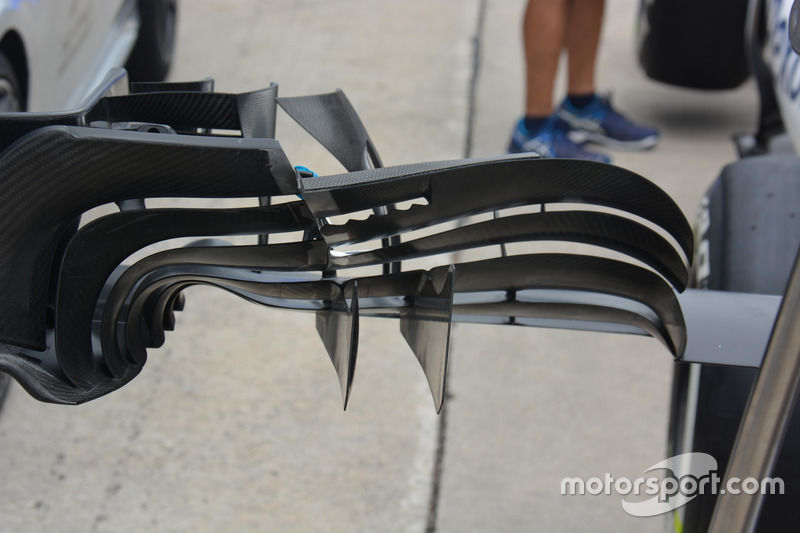
The wing features five serrated ‘teeth’ on the trailing edge of the slot that punctuates the upper flap. It’s a design feature that we’ve seen used by Mercedes since Japan last year and more recently trialled by both Red Bull and Ferrari in China and Singapore respectively.
The difference with the Williams variant is that these serrations are only placed in the slot, rather than a significant length of the penultimate flap. Furthermore, the serrations are rather large, whereas the other designs seen more recently by Red Bull and Ferrari have tended to use smaller elements.
These serrations are designed to improve the efficiency of the flapped section both below them and that resides above, allowing steeper angles of attack to be used without fear of flow separation.
It’s also important to note that the slot and serrations are in line with the vertical strakes, which also shape and improve the distribution of the airflow underneath the wing.
Share Or Save This Story

The fascinating story behind McLaren's most iconic F1 car

Emilia Romagna GP: F1 technical images from Imola's pitlane

The F1 downforce choices that proved key at the Saudi GP


100 not out: Alex Albon on Williams’s desire to atone for its 2026 struggles

James Vowles reveals Williams F1 cost cap struggle amid facility overhaul

F1 2026 mid-season grades: Williams takes shocking step backwards

Kasey Kahne is as passionate and competitive as ever at Knoxville Nationals

Knoxville Nationals feature hasn't had a lead change in three years

Ty Gibbs wants to see what NASCAR would look like without digital mirrors

Daniel Dye secures four-race NASCAR O'Reilly deal with Jordan Anderson Racing

Top 10 rookie seasons in F1

Why F1 shouldn’t be hiding its most interesting characters
100 not out: Alex Albon on Williams’s desire to atone for its 2026 struggles

Why it will “take years” for Cadillac to reach the level F1 rivals are operating at
Subscribe and access Motorsport.com with your ad-blocker.
From Formula 1 to MotoGP we report straight from the paddock because we love our sport, just like you. In order to keep delivering our expert journalism, our website uses advertising. Still, we want to give you the opportunity to enjoy an ad-free and tracker-free website and to continue using your adblocker.


Top Comments