Analysis
Formula 1 Spanish GP
F1 tech: A close look at Aston Martin's controversial upgrades
The upgrade package introduced by Aston Martin ahead of the Spanish Grand Prix is one of the most extensive on show in Barcelona, much of which draws parallels with the Red Bull RB18’s design.

Matt Somerfield
Edited: May 25, 2022, 5:23 PM
Copy link
Share on Viber
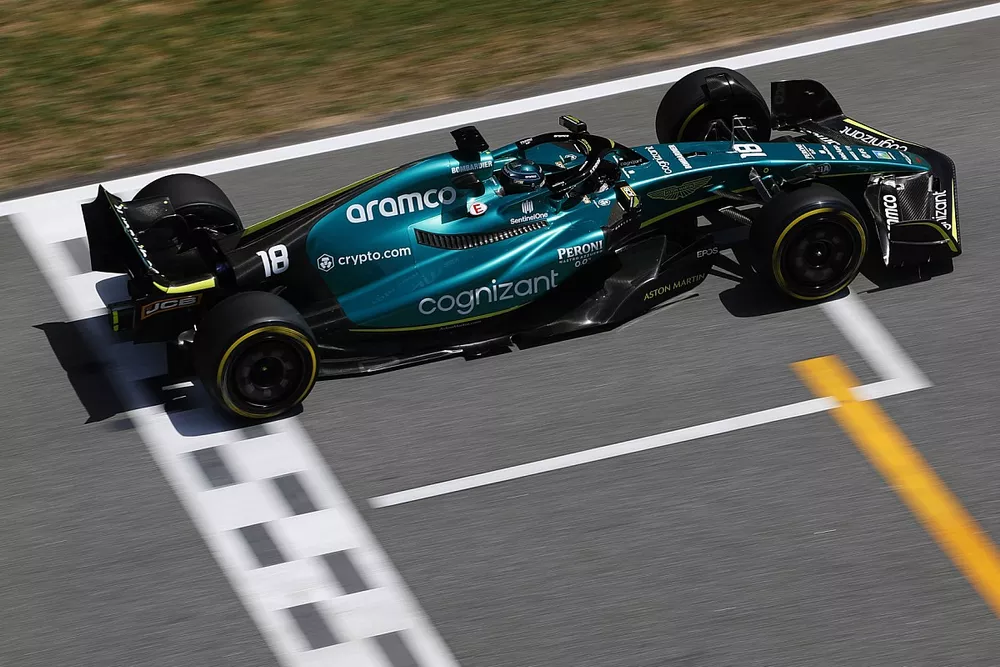
However, there are some other changes – both big and small – that differentiate it from the car that was last rolled out in Miami.
First up, the team has introduced a new rear wing configuration, with an onus on increasing downforce for the challenges posed by both the Circuit de Barcelona-Catalunya and Monaco that the wings already at its disposal wouldn’t have resolved.
The design is most closely aligned to the one used in Bahrain, with the elements filling up more of the legality box and being angled more steeply too.
The team has also used different downforce offerings at the other circuits, with a spoon-shaped design to help reduce downforce and drag was deployed at both Jeddah and Miami, and a more conventional shape was favoured in Imola.
Aston Martin AMR22 rear wing comparison
Photo by: Uncredited
There have also been several changes to the halo and its fairing, not least the change from green paint in the front section to black instead, which begs the question as to why it didn’t choose to save even more weight and just leave it carbonfibre.
The team also mounted a new pair of fins on the rear upper section of the halo for FP1 that they removed during the session (red arrow), whilst another fin has been added ahead of the rear mounting (blue arrow), which is likely an improvement based on the side-mounted winglet that’s been taken on and off the car during the first few races (purple arrow).
Aston Martin AMR22 Halo winglets
Photo by: Uncredited
Moving down the car, the first elements that we come across that bear all the hallmarks of the Red Bull RB18 design philosophy is Aston Martin’s switch to the twin outer floor strake layout that, until now, had been individual to Red Bull.
Aside from them being stacked next to one another they also feature a stepped design ahead of the transition into the floor, which should produce vortices that interact with one another and increase performance locally and downstream.
Read Also:
- Aston Martin reveals 'Green Red Bull' overhaul ahead of Spanish GP
- FIA clears Aston over Red Bull F1 similarities after investigation
Aston Martin AMR22 side detail
Photo by: Giorgio Piola
By far the biggest change made by Aston Martin in Spain is the sidepods, as it becomes the first team to make a U-turn and produce something similar to another challenger in a quest for more performance.
The challenges posed by such an undertaking should not be underestimated either, as it has not only required an aerodynamic rethink of the external surfaces but also adaptation of the internal layout of the heat exchangers, electronics and ancillaries housed within the sidepods.
In its original guise the AMR22’s sidepod internals (inset) were much more reclined, which resulted in the ‘hanging’ sidepod bodywork solution that provided a large undercut for the airflow to make an unobstructed journey along the car’s flank.
In order to better manage the airflow at the rear of the car, the designers also incorporated large cooling gills on the sidepod’s upper surface.
Aston Martin AMR22 radiator layout comparison
Photo by: Giorgio Piola
The new configuration largely does away with this arrangement, as the internal components have been reoriented, with the heat exchangers inclined so they take up a more conventional position within.
As a consequence the inlet has also been pushed back, which the team hopes will still provide the necessary flow to cool the internals but also influence the external airflow more effectively too.
This is aided by the team's approach to the shape of the bodywork that surrounds the inlet, with the overall design clearly influenced by the Red Bull RB18 but requiring its own take in order to extract the performance it is looking for. For example, the RB18 has an extended lip ahead of the inlet, which creates an open top, increasing the volume of air that can be captured – but the AMR22’s version does not.
The shoulder of the sidepod also has more of a bluff surface than its Red Bull counterpart, as the Aston designers look for their own way in which to push the tyre wake laterally that it encounters.
There is some similarity in the design of the wing mirror housing, the stalks and the ancillary winglets that grow from them. But whereas the RB18’s wing mirror sits astride the outer sidepod boundary winglet, the AMR22’s does not – it remains independent of it.
The large forward undercut and Z-shaped downwash contouring seen on Red Bull’s sidepods is also present on the Aston Martin which bleeds into another region where we can now see similarities between the two: the floor edge.
Aston Martin had already deployed an edge wing at the more central point of the floor but it has been transformed to align with the sidepods’ new, wider waistline and features a slot ahead of a wavy section before the floor tapers away ahead of the rear tyre.
It’s also worth noting that while much of the heat rejection duty now falls on the enlarged rear cooling outlet, the team still has the option to open up cooling on the side of the car, with a similar design to the Red Bull employed here once again.
Just as Red Bull has done, there are also options of how much of those cooling gills needs to be opened up in order that aerodynamic performance isn’t compromised.
Aston Martin AMR22 bodywork detail
Photo by: Giorgio Piola
Aston Martin AMR22 rear detail
Photo by: Giorgio Piola
Read Also:
- Horner: Copy row no coincidence after Red Bull staff joined Aston Martin
- What F1's rule book says on Aston Martin's Red Bull clone
We want your opinion!
What would you like to see on Motorsport.com?
Take our 5 minute survey.
- The Motorsport.com Team
Read and post comments
Read also :
Share Or Save This Story
Copy link
Share on Viber
Previous article Spanish GP: Leclerc grabs pole as Verstappen hits trouble
Next article DRS issue behind Verstappen's Spain Q3 slow-down
Top Comments
There are no comments at the moment. Would you like to write one?
View More & Comment

More from
Matt Somerfield

Gallery: How F1 tech evolved during the 2024 season
Formula 1
Formula 1
Gallery: How F1 tech evolved during the 2024 season
How McLaren’s rear wing push changed the game in F1
Formula 1
Formula 1
How McLaren’s rear wing push changed the game in F1
How 2026 F1 rules will help avoid identikit designs
Formula 1
Formula 1
How 2026 F1 rules will help avoid identikit designs
Latest news

Tim Clark wants NASCAR to be better storytellers to counter "brand perception problem"
NASCAR Cup
NAS NASCAR Cup 41 min
Tim Clark wants NASCAR to be better storytellers to counter "brand perception problem"

Why NASCAR's Zane Smith fine for Carson Hocevar contact was consistent
NASCAR Cup
NAS NASCAR Cup
Talladega II
1 h
Why NASCAR's Zane Smith fine for Carson Hocevar contact was consistent

Jimmie Johnson on the NASCAR business world: "It's a war"
NASCAR Cup
NAS NASCAR Cup 1 h
Jimmie Johnson on the NASCAR business world: "It's a war"
David Alonso lashes out at Dani Holgado: "When you’re not a good person, there’s nothing you can do"
Moto2
MOT2 Moto2
Phillip Island
1 h
David Alonso lashes out at Dani Holgado: "When you’re not a good person, there’s nothing you can do"
Feature
Discover prime content


Subscribe and access Motorsport.com with your ad-blocker.
From Formula 1 to MotoGP we report straight from the paddock because we love our sport, just like you. In order to keep delivering our expert journalism, our website uses advertising. Still, we want to give you the opportunity to enjoy an ad-free and tracker-free website and to continue using your adblocker.
You have 2 options:
- Become a subscriber.
- Disable your adblocker.
Subscribe now Already subscribed? Sign in here
Already disabled your adblocker?
Reload page
Manage Alerts
Subscribe