Analysis
Formula 1
2019 tech verdict: Ferrari founders, but then finds form
Join us as we delve into Giorgio Piola’s 2019 archive and bring you insight into the relentless development undertaken by the teams throughout a season in the pursuit of more performance. In today’s gallery we will focus on… Ferrari.
Giorgio Piola Matt Somerfield
Edited: Dec 28, 2019, 7:56 PM
Copy link
Share on Viber
Giorgio Piola's F1 technical analysis
Giorgio Piola is the preeminent Formula 1 technical journalist. View our full selection of Giorgio's technical illustrative content
After winning the pre-season testing war, this was the year that Ferrari was supposed to truly challenge Mercedes for the world championship. So what went wrong?
Besides Bahrain, where newcomer Charles Leclerc was robbed of a first win due to an engine problem, its early-season form was poor and a lack of downforce was apparent. Only when the season hit the lower-downforce or power-dependent circuits – like Montreal, the Red Bull Ring, Spa and Monza – did the slippery SF90 truly come into its own.
Its power output soon became a focus of attention, with rivals seeking FIA technical clarifications in an attempt to negate its advantage. Ferrari did make decent steps with its car’s balance and downforce levels as the season developed, proved by Sebastian Vettel's win in Singapore, but by the time it was in a position to challenge Mercedes the title race was already over.
Click on the arrows on the images below to scroll through them…
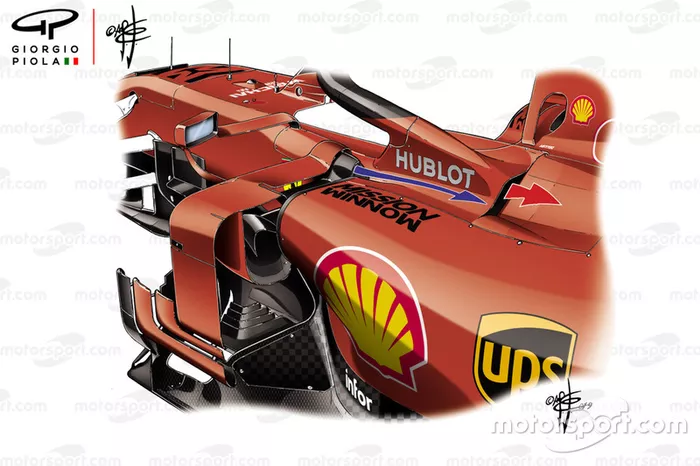
Ferrari’s sidepod and cooling game really lifted back in 2017 when it was the first to adopt the low-slung side impact spar and pushed back sidepod inlet. The regulation changes for 2019 were widesweeping but none had a severe effect on this area of the car, so gains here might be seen as minimal. Ferrari was still keen to make improvements here though, utilising a flow-through duct alongside the chassis (blue arrow), while also following on from the example set by others when it comes to using the tail-end of the halo transition for cooling.
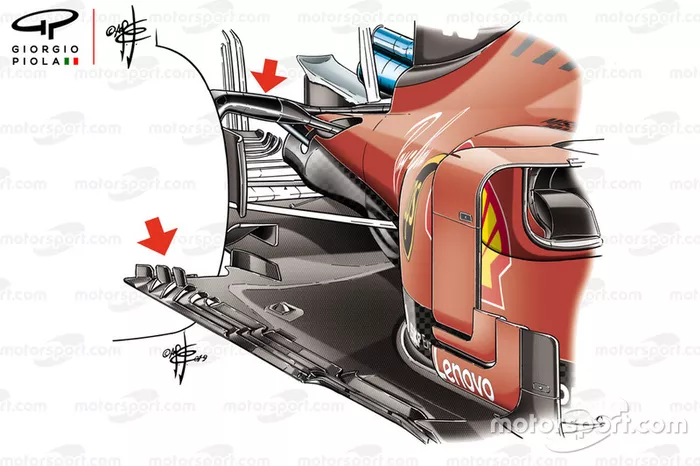
Having already tested vertical fins on the floor ahead of the rear wheels at Austin in 2018, the team pushed on with the concept for 2019. The fins help to improve flow circulation ahead of the rear wheels, helping to reduce the negative aerodynamic impact that the wheel wake and tyre squirt can create.
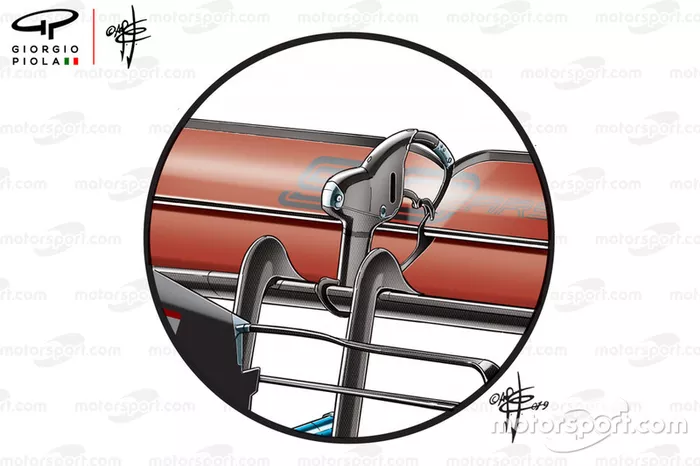
Ferrari, like several other teams, used a tail section on the DRS pod for 2019. This stabilises the rear wing when DRS is activated, preventing the flap from over-extending.
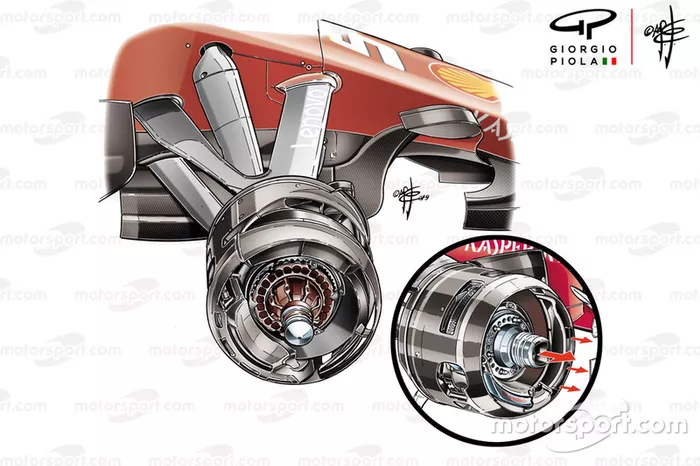
For a number of years Ferrari has been using a blown axle solution (inset) which collected airflow at the inlet and fed it through the centre of the wheel to reduce the aerodynamic wake created by the wheel and tyre that can have a negative effect on the rest of the car. With blown axles banned for 2019, the team looked for ways to recover some of the effects it previously enjoyed and so expanded on the outer channels that drive airflow through the wheel rim instead.
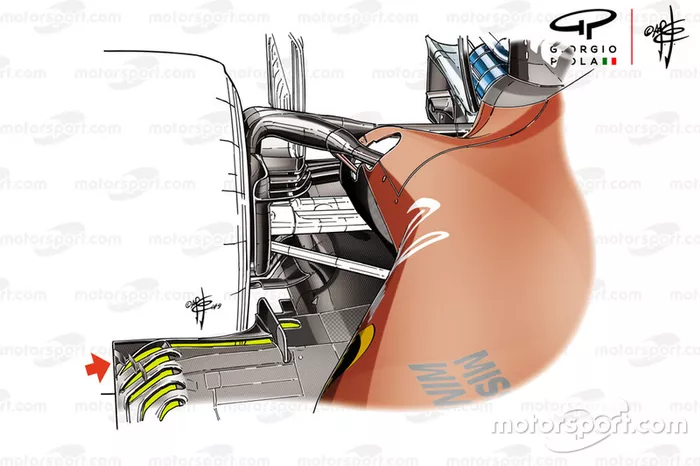
Further development of the floor slots ahead of the rear wheels was undertaken for the Azerbaijan GP, with the rearmost slot extended all the way across to the vertical strake and another slot added on the other side of it.

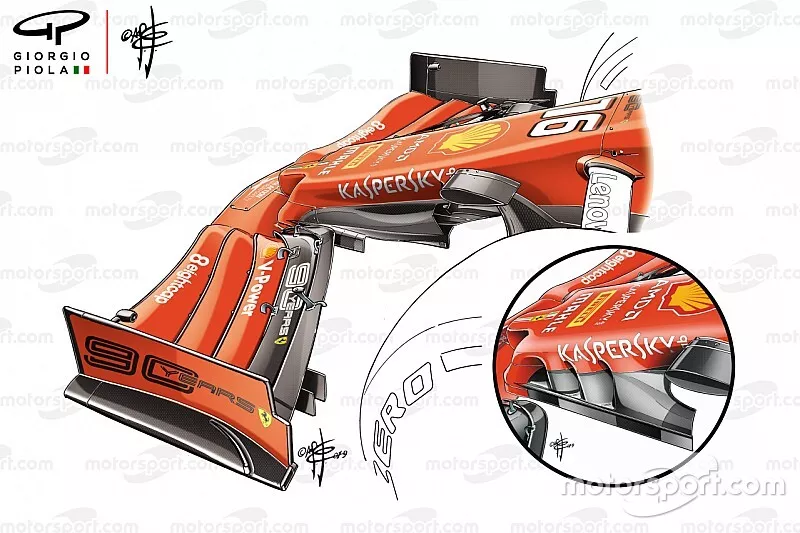
Ferrari’s front wing is the unloaded variant – a design that sees the outer portion of the wing reduced in height near the endplate to reduce the strength of the vortex created here.

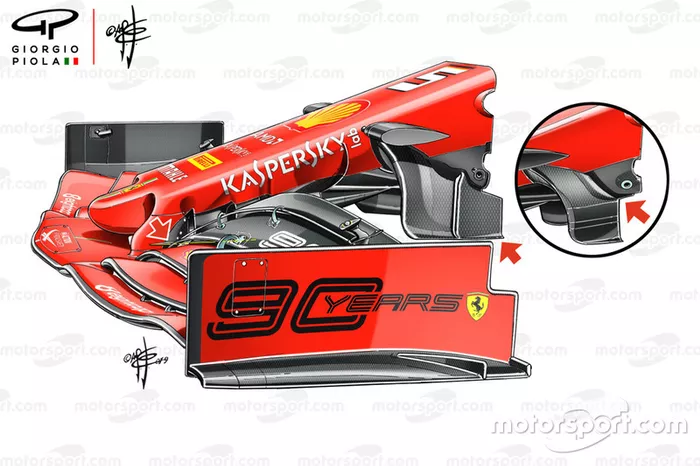
For the Spanish GP, Ferrari decided to make some alterations to the front wing, changing the bend in the endplate, whilst also adding a small triangular Gurney-like tab before the trailing edge of the footplate.
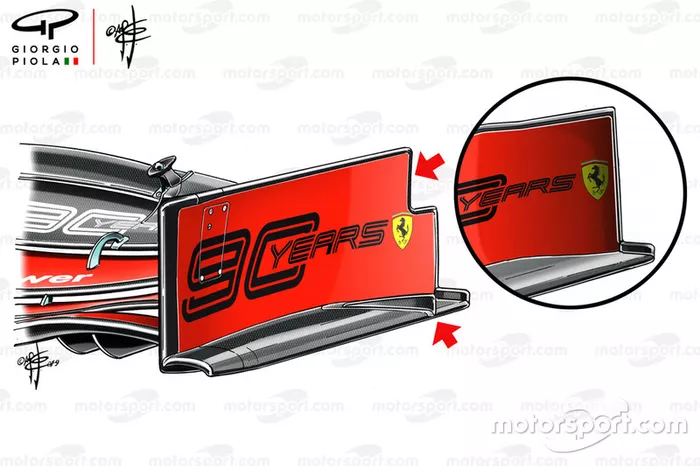
The changes seen here from the side also show how a notch was removed from the upper rear corner of the endplate too.
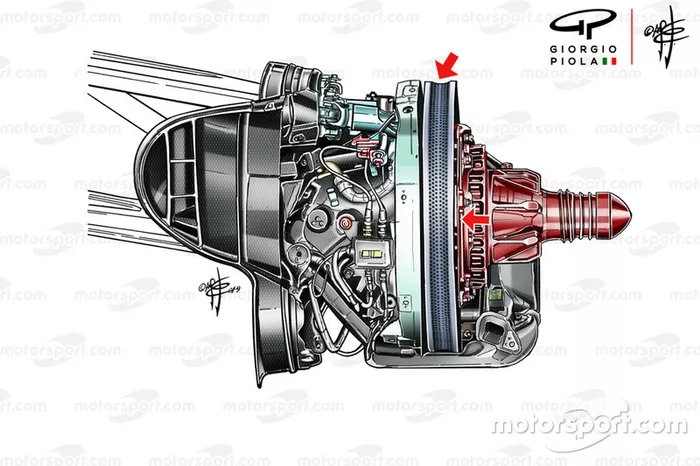
Seen here at the Austrian GP, Ferrari used a scalloped face on the brake disc when it needed maximum cooling, as this design increased the total surface area available.

This illustration of the rear wing from the Austrian GP shows how the team used multiple strakes on the upper section of the endplate to improve the overall performance of the wing.
The team also made changes to the nose and turning vanes for the Austrian GP, with an additional longitudinal strake added at the base of the wing pillars to help improve flow around and through the slots, while the rear vane usually hung from the underside of the nose was moved back onto the chassis.

This rearward image of the front wing pillars affords a better view of the strake introduced to help with airflow management.

The team introduced a new bargeboard arrangement for the Hungarian GP in an effort to improve downforce deficiencies.
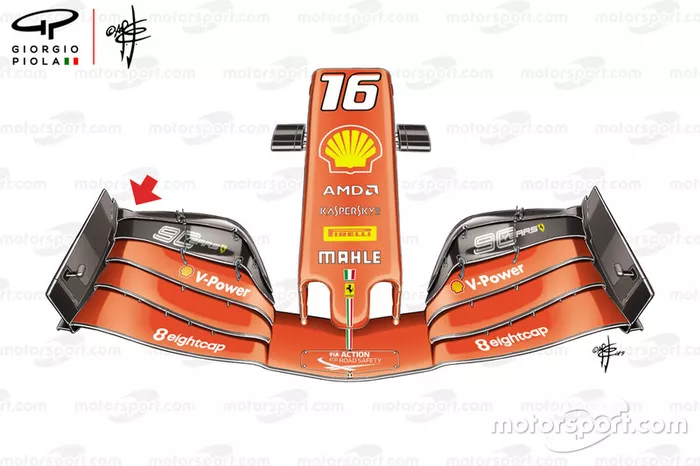
Already the cream of the crop in a straightline, the Scuderia were looking to devastate rivals at the ‘Temple of Speed’ and ran with an extremely skinny upper flap configuration at Monza.
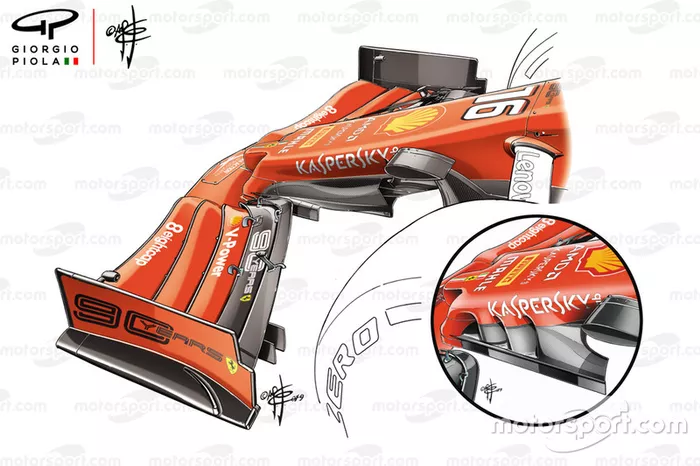
In a bid to resolve its higher downforce woes, the Scuderia installed a new nose solution for the Singapore GP, which incorporated the under-nose cape solution used widely up and down the grid. This side-by-side comparison gives us a clearer understanding of how it achieved its installation with the cape integrated into the front wing pillars.
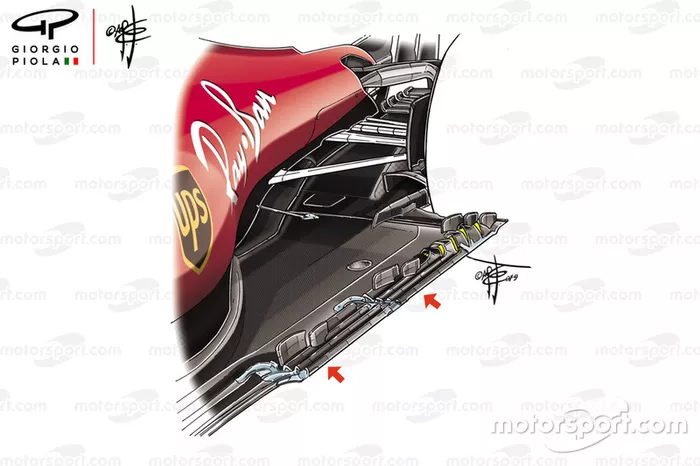
Ferrari made further changes to its floor in a bid to improve downforce and aerodynamic consistency too, integrating metal stiffeners in the floor where it was prone to flexing under load.
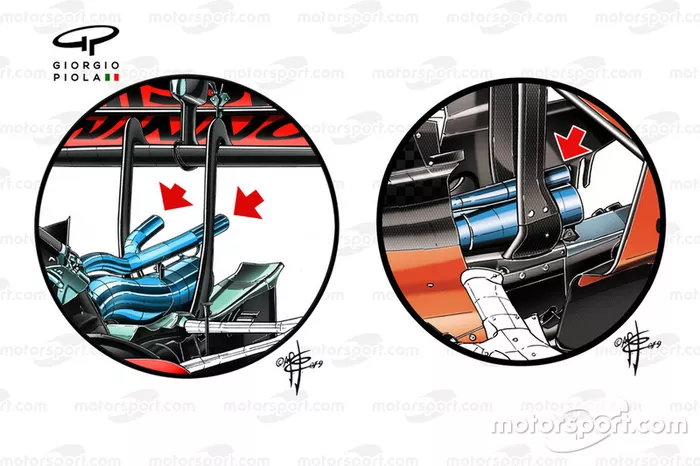
With an eye on 2020, Ferrari arrived at the last race of the season with a new solution to test that sees the wastegate pipework once again split into two. It bears a significant resemblance to the design that Red Bull ran in the latter phases of its campaign with the tailpipes turned up to face the underside of the wing.
17
Read Also:
- 2019 tech verdict: Red Bull becomes a disruptor with Honda
- 2019 tech verdict: McLaren on the road to recovery
- 2019 tech verdict: Renault reaches ahead, but falls back
- 2019 tech verdict: Podium joy as Toro Rosso jumps forward
- 2019 tech verdict: Racing Point shows encouraging signs
- 2019 tech verdict: Alfa’s battle to find consistency
- 2019 tech verdict: Haas suffers a season to forget
- 2019 tech verdict: How Williams struggled from the start
We want your opinion!
What would you like to see on Motorsport.com?
Take our 5 minute survey.
- The Motorsport.com Team
Read and post comments
Read also :
Share Or Save This Story
Copy link
Share on Viber
Previous article Hamilton still revisits texts from "great pillar" Lauda
Next article Kubica: Tough 2019 season worth it to "close a chapter"
Top Comments
There are no comments at the moment. Would you like to write one?
View More & Comment
More from
Giorgio Piola

The fascinating story behind McLaren's most iconic F1 car
Formula 1
Formula 1
The fascinating story behind McLaren's most iconic F1 car

Emilia Romagna GP: F1 technical images from Imola's pitlane
Formula 1
Formula 1
Emilia Romagna GP
Emilia Romagna GP: F1 technical images from Imola's pitlane

The F1 downforce choices that proved key at the Saudi GP
Formula 1
Formula 1
Saudi Arabian GP
The F1 downforce choices that proved key at the Saudi GP

More from
Ferrari
The figures that show Mercedes has lost its supremacy in F1 2026
Formula 1
Formula 1
United States GP
18 h
The figures that show Mercedes has lost its supremacy in F1 2026
Ferrari promotes F2 racer to F1 reserve driver role
Formula 1
Formula 1
Singapore GP
Ferrari promotes F2 racer to F1 reserve driver role

Latest news
NASCAR explains why they penalized Zane Smith after latest clash with Carson Hocevar
NASCAR Cup
NAS NASCAR Cup
Phoenix II
12 h
NASCAR explains why they penalized Zane Smith after latest clash with Carson Hocevar

Porsche boss Laudenbach says he is "not happy" with how things were handled by IMSA in 2026
IMSA
IMSA IMSA 13 h
Porsche boss Laudenbach says he is "not happy" with how things were handled by IMSA in 2026
Five things to watch out for at the F1 United States GP
Formula 1
F1 Formula 1
United States GP
13 h
Five things to watch out for at the F1 United States GP
KTM sees MotoGP 2027 as a fresh start: “We never had the chance to build a new bike”
MotoGP
MGP MotoGP 14 h
KTM sees MotoGP 2027 as a fresh start: “We never had the chance to build a new bike”
Feature
Discover prime content



Subscribe and access Motorsport.com with your ad-blocker.
From Formula 1 to MotoGP we report straight from the paddock because we love our sport, just like you. In order to keep delivering our expert journalism, our website uses advertising. Still, we want to give you the opportunity to enjoy an ad-free and tracker-free website and to continue using your adblocker.
You have 2 options:
- Become a subscriber.
- Disable your adblocker.
Subscribe now Already subscribed? Sign in here
Already disabled your adblocker?
Reload page
Manage Alerts
Subscribe