Breaking news
Formula 1
Wolff: Engine mode ban can make Mercedes faster in race
Mercedes Formula 1 boss Toto Wolff believes the upcoming ban on engine modes in qualifying will potentially give the team more performance in races.

Adam Cooper
Edited: Aug 20, 2020, 8:21 AM
Copy link
Share on Viber

The FIA wrote to the teams last week informing them of a plan to allow only one mode for qualifying and the race, with details to be confirmed by a technical directive before the Belgian GP.
The change has been framed by the FIA as an attempt to help its technical staff a better chance of ensuring compliance with the regulations.
However, inevitably many observers see it also as an attempt to rein in Mercedes, the manufacturer that has traditionally made the biggest performance gains when it matters in qualifying.
“I think the primary goal of the FIA was to implement the rule to better understand and better analyse what is going on with the engines,” said Wolff.
“It’s a very complex method between the combustion engine and all the energy recovery system, and having one mode it becomes more easy for the FIA to really see if everything is in compliance.”
Regarding the suggestion that Mercedes was being reined in, he said: “It has always been the case in F1 that pulling back the leaders, or what supposedly are the leaders, is something that is good for the sport.
“We see it very much as a challenge. We have a good quali mode and we are able to give it a little bit more power in that last session.
“But if that is not possible anymore because everything needs to be smoothed out over the race, then it’s not a deficit for us.
“On the contrary, we think we can translate it into more performance in the race. That is something that is a great challenge for us that will take on once the rule is implemented.”
Read Also:
- FIA confident that engine mode rule can be policed
- Hamilton: F1 engine mode ban won't "get the result they want"
- F1 qualifying engine modes ban "only a positive" for Ferrari
Elaborating on that theme, Wolff made it clear that qualifying modes currently have a cost in terms of how much performance is then available for races.
Thus it follows that if qualifying modes cannot be used then the power unit can potentially be run harder in races.
“I think we don’t lack performance on Saturdays. We had until now quite a margin. We struggled in some of the races where we were quite limited in powerful engine modes, and if F1 were to ban in-season certain power unit modes, then I think it will actually help us in the race.
“If you can avoid damaging your power unit in those few qualifying laps that you have available, in Q3 and then the odd lap in the race, the damage metrics goes down dramatically.
“So five laps of quali mode not being done gives us 25 laps of more performance in the race, and that is something we believe will give us more performance.
“You must take into effect even if it may hurt us more in qualifying, which I’m not sure, and it’s a couple of tenths, then it will hurt all the others in the same way.
“But for us, we are always very marginal on what we can extract from the power unit, and if we were to be limited in qualifying modes, then well, we will be stronger in the race.”
We want your opinion!
What would you like to see on Motorsport.com?
Take our 5 minute survey.
- The Motorsport.com Team
Read and post comments
Read also :
Share Or Save This Story
Copy link
Share on Viber
Previous article Mercedes made “wrong decision” on Spanish GP strategy
Next article McLaren: Testing at new F1 tracks would send “wrong sign”
Top Comments
There are no comments at the moment. Would you like to write one?
View More & Comment
More from
Adam Cooper

RB: Tsunoda “mentally on a different level” in 2024
Formula 1
Formula 1
Japanese GP
RB: Tsunoda “mentally on a different level” in 2024

Andretti planning F2 and F3 entries to promote US talent to F1 team
Formula 1
Formula 1
Andretti planning F2 and F3 entries to promote US talent to F1 team

Andretti F1 team formally opens new Silverstone facility
Formula 1
Formula 1
Andretti F1 team formally opens new Silverstone facility
More from
Mercedes
Kimi Antonelli hails "step forward" at United States GP as Mercedes chips away at upgrades
Formula 1
Formula 1
United States GP
13 h
Kimi Antonelli hails "step forward" at United States GP as Mercedes chips away at upgrades

George Russell reveals he lost sleep over his own driving, not the F1 championship
Formula 1
Formula 1
United States GP
George Russell reveals he lost sleep over his own driving, not the F1 championship

Latest news

NASCAR Cup Talladega starting lineup: Chase Briscoe beats Austin Hill for pole
NASCAR Cup
NAS NASCAR Cup
Talladega II
56 min
NASCAR Cup Talladega starting lineup: Chase Briscoe beats Austin Hill for pole
F1 United States GP: Lewis Hamilton pips Max Verstappen in FP3
Formula 1
F1 Formula 1
United States GP
1 h
F1 United States GP: Lewis Hamilton pips Max Verstappen in FP3
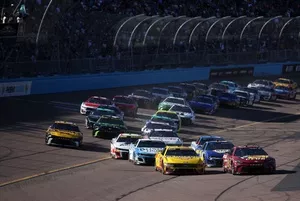
NASCAR plans to modify Phoenix dogleg to lessen driver loads
NASCAR Cup
NAS NASCAR Cup
Phoenix II
1 h
NASCAR plans to modify Phoenix dogleg to lessen driver loads
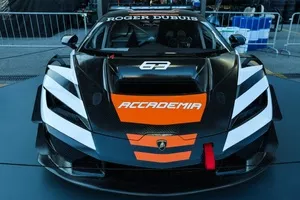
Lamborghini | Barcelona selected to host the 2027 Super Trofeo World Finals
Lamborghini Super Trofeo
LBST Lamborghini Super Trofeo
World Finals - Monza 2026
2 h
Lamborghini | Barcelona selected to host the 2027 Super Trofeo World Finals
Feature
Discover prime content



Subscribe and access Motorsport.com with your ad-blocker.
From Formula 1 to MotoGP we report straight from the paddock because we love our sport, just like you. In order to keep delivering our expert journalism, our website uses advertising. Still, we want to give you the opportunity to enjoy an ad-free and tracker-free website and to continue using your adblocker.
You have 2 options:
- Become a subscriber.
- Disable your adblocker.
Subscribe now Already subscribed? Sign in here
Already disabled your adblocker?
Reload page
Manage Alerts
Subscribe