Formula 1
Pirelli counters Hamilton 'peaky F1 tyres' frustration
Pirelli does not agree with Lewis Hamilton’s assessment that Formula 1’s current tyres are the peakiest ever.

Jonathan Noble
Edited: Jun 3, 2024, 2:00 PM
Copy link
Share on Viber
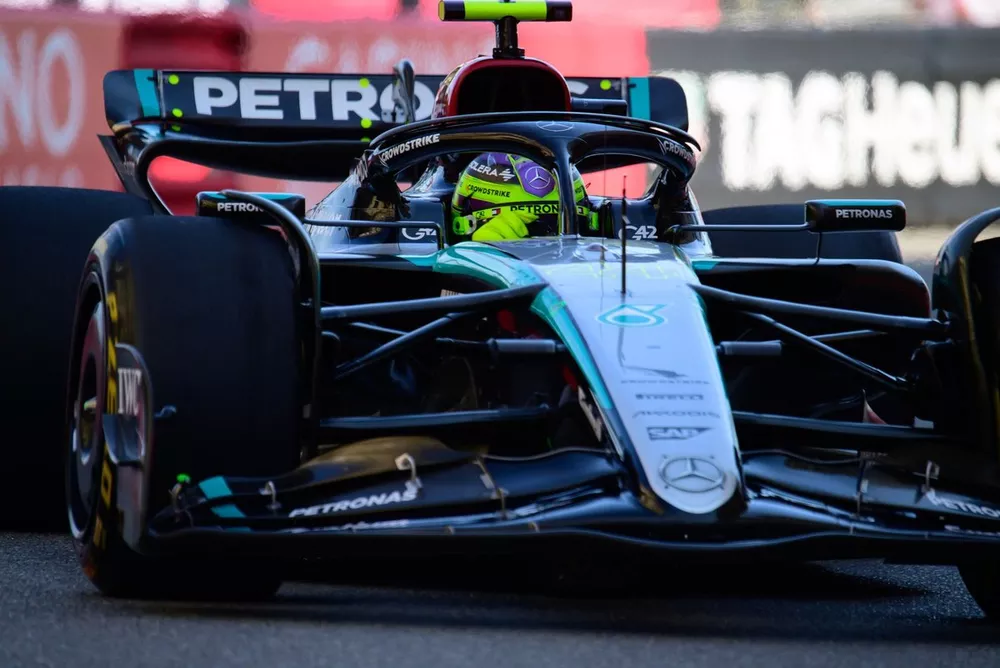
Hamilton suggested after the Miami Grand Prix last month that he had never known F1 tyres to have as "minuscule" an operating window as they do right now.
"Honestly, it's probably the most frustrating thing," said the seven-time world champion. "You look back in the day when you had a much bigger working window to work with.
"Then you can just optimise the balance and then just have good grip throughout the whole lap. This is definitely my least favourite."
But Pirelli thinks the importance of the peakiness of the tyres is not because their characteristics are different, but that the F1 field is now so close that every detail counts more.
In the past, when there were several tenths of a second in laptime difference between cars, being in and out of the tyre window slightly was not really critical to performance.
Asked about Hamilton's viewpoint on peakiness, Pirelli's F1 chief engineer Simone Berra said: "Every tyre has a peak at some point and the operating window is always just a definition. We take a certain percentage of grip loss to define the window.
"I think even in the past it was the same. But probably it was less critical because the level of detail that we have at the moment is quite significant.
"That's why now everything is highlighted and important. In the past, 15-20 years ago, you had cars or drivers even divided by half a second or seven-tenths of a second so it was not so narrow.
Photo by: Sam Bloxham / Motorsport Images
"But the fight now is completely different, and even one-tenth of a second makes a great difference."
Berra also thinks that the situation of how peaky tyres are also varies from car to car, and can also be different across compounds.
"We know very well that especially C4, and in some cases obviously with high temperature the C5, there can be a peaky performance.
"Some teams are less able compared to others to extract the peak of performance. Part of it is the tyre, yes honestly it is, but part of it is as well, the car, the suspension, and how the car is, exploiting the compound performance. So, it's both factors."
What is peak grip?
Pirelli explained recently how it defines the working range of the tyre to be the temperature area that is within 3% of the peak grip possible.
With margins close in F1 right now, it has become obvious that the closer drivers can get their tyres to the absolute peak the better it is.
As Pirelli's head of car racing and F1 Mario Isola explained relating to the above graphic: "If we look at a graph, the grip of the tyre is on the vertical coordinates and the temperature is on the horizontal.
"In the cold, any compound that is developed for motorsport has little grip. Instead, the grip increases as the temperature goes up.
"There is a curve that goes up until it reaches a peak, and then beyond that there will be a significant drop in grip due to overeating."
Working out where this peak grip is delivered then allows teams to understand what the working range of the tyre is.
Isola added: "Once the peak of grip has been reached, at the highest point of the curve, the graph normally shows us a 3% area that we define as the 'working range'. There is then a curve between two points that we try to make flatter and, above all, as wide as possible.
"Our goal is to give the drivers a tyre with a wide plateau, to ensure a bigger operating window."
Photo by: Pirelli
We want your opinion!
What would you like to see on Motorsport.com?
Take our 5 minute survey.
- The Motorsport.com Team
Read and post comments
Read also :
Share Or Save This Story
Copy link
Share on Viber
Previous article Red Bull braced for tough Canada test amid F1 kerb struggles
Next article Ocon to leave Alpine after 2024 F1 season
Top Comments
There are no comments at the moment. Would you like to write one?
View More & Comment

More from
Jonathan Noble

Brundle awarded OBE in King’s New Year’s honours
Formula 1
Formula 1
Brundle awarded OBE in King’s New Year’s honours
The new rules dilemma that will define the 2025 F1 season
Formula 1
Formula 1
The new rules dilemma that will define the 2025 F1 season
Verstappen issues Red Bull title warning in push for RB21 progress
Formula 1
Formula 1
Australian GP
Verstappen issues Red Bull title warning in push for RB21 progress
Latest news
On this day: Fernando Alonso wins the world title, Michael Schumacher retires from F1
Formula 1
F1 Formula 1
Brazilian GP
45 min
On this day: Fernando Alonso wins the world title, Michael Schumacher retires from F1

Raul Fernandez still compromised after Indonesia finger injury: “I’m not at 100%”
MotoGP
MGP MotoGP
Australian GP
1 h
Raul Fernandez still compromised after Indonesia finger injury: “I’m not at 100%”

MotoGP can’t simply copy F1’s Drive to Survive success – Chase Carey
MotoGP
MGP MotoGP
Australian GP
2 h
MotoGP can’t simply copy F1’s Drive to Survive success – Chase Carey
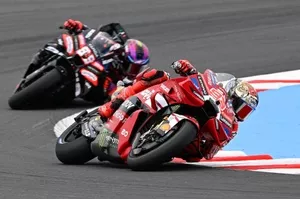
Marc Marquez's mind games with Jorge Martin: "If you're fast, you don't need team orders"
MotoGP
MGP MotoGP
Australian GP
2 h
Marc Marquez's mind games with Jorge Martin: "If you're fast, you don't need team orders"
Feature
Discover prime content


Subscribe and access Motorsport.com with your ad-blocker.
From Formula 1 to MotoGP we report straight from the paddock because we love our sport, just like you. In order to keep delivering our expert journalism, our website uses advertising. Still, we want to give you the opportunity to enjoy an ad-free and tracker-free website and to continue using your adblocker.
You have 2 options:
- Become a subscriber.
- Disable your adblocker.
Subscribe now Already subscribed? Sign in here
Already disabled your adblocker?
Reload page
Manage Alerts
Subscribe