Special feature
Formula 1
Banned: Why Renault's mass damper was outlawed
At the height of Renault's success in the mid 2000s, the French car manufacturer utilised a solution known as the 'mass damper', and started a development war that had every chance of getting out of hand if the FIA had not stepped in.
Matt Somerfield Giorgio Piola
Edited: Jun 22, 2022, 10:15 PM
Copy link
Share on Viber
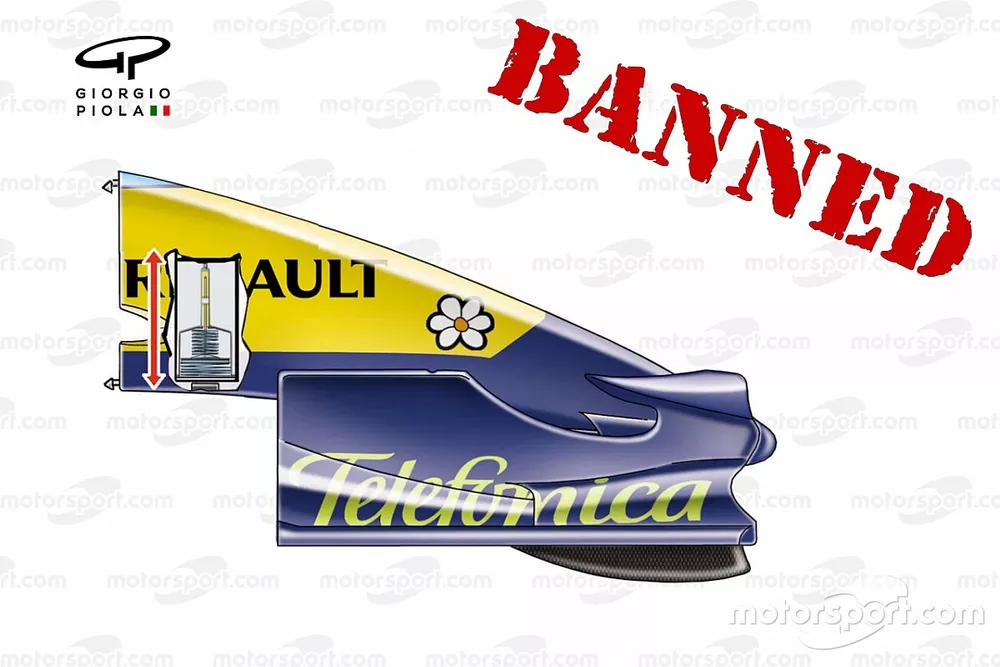
Giorgio Piola's F1 technical analysis
Giorgio Piola is the preeminent Formula 1 technical journalist. View our full selection of Giorgio's technical illustrative content
Renault's mass damper is a typical example of Formula 1 teams using their ingenuity and lateral thinking to find a way around a problem, and then exploit it even further.
The Enstone-based team had found the rules introduced for 2005 required it to run an excessive amount of front spring stiffness to keep the front wing as close as possible to the ground.
This was the sort of mechanical trade-off that teams typically make to try to find aerodynamic performance. However, this set off an unwanted bounce effect when the car was in pitch, and so a push was made to try to find a way of counteracting its effect.
Cars of this era were able to make the weight limit relatively easy when compared with their modern counterparts, and so often ballast was carried to bring the car up to the minimum weight. This gave Renault license to install its mass damper - a free moving weight suspended within a cylinder inside the nosecone that would act in opposition to the vertical forces applied to the car.
The benefits of such a device clearly had to exceed the additional weight that was being carried, especially as one of the drawbacks was its location: with ballast usually cited at the lowest possible point on the car.
Nonetheless, extensive tests on the team's 7-post shaker rig had already confirmed that a lap time gain was possible, and so it put it into production. Renault immediately found that the mass damper would not only settle the car, but also allow their drivers to attack the kerbs much harder, giving a more compliant ride and a more stable aerodynamic platform.
The team initially used a weight of around 10kg but swiftly realised that this could be customised for each circuit, with various weights used in order to get the best from the car and latterly added a mass damper at the rear of the car too.
Renault R26 2006 exploded overview
Photo by: Giorgio Piola
During this era of F1, there were two tyre suppliers - Bridgestone and Michelin, of which Renault was supplied by the latter. This was even more of a coup for Renault as it's understood that the Michelin tyres were more receptive to the use of the mass damper, as the tread block tended to move around more when exerted.
That wouldn't stop others attempting to make similar gains though, as whilst Renault may have been the first, others quickly followed suit. In fact, most of the field started employing them to a varying degree of success and with ever-more complex modality and weight.
In the end, the FIA used its catch-all regulation that outlawed 'moveable aerodynamic devices'. It cited an escalation in development of the devices which had highlighted that their primary purpose was no longer to provide additional mechanical assistance but instead was being used to markedly improve the car's aerodynamic output.
Read Also:
- Banned: Why Mercedes' double DRS was outlawed
- Banned: Why McLaren's F-duct was outlawed
- Banned: Why F1 moved to outlaw crazy X-wings
- Banned: Why Lotus' twin-chassis concept was outlawed
We want your opinion!
What would you like to see on Motorsport.com?
Take our 5 minute survey.
- The Motorsport.com Team
Read and post comments
Read also :
Share Or Save This Story
Copy link
Share on Viber
Previous article Pironi – The man who should have been France’s first F1 champ
Next article Why one of F1’s best overtakes is dismissed by the attacker
Top Comments
There are no comments at the moment. Would you like to write one?
View More & Comment

More from
Matt Somerfield

Gallery: How F1 tech evolved during the 2024 season
Formula 1
Formula 1
Gallery: How F1 tech evolved during the 2024 season
How McLaren’s rear wing push changed the game in F1
Formula 1
Formula 1
How McLaren’s rear wing push changed the game in F1
How 2026 F1 rules will help avoid identikit designs
Formula 1
Formula 1
How 2026 F1 rules will help avoid identikit designs
Latest news

Charles Leclerc reacts to Ferrari fear: 'We know what line not to cross'
Formula 1
F1 Formula 1
United States GP
52 min
Charles Leclerc reacts to Ferrari fear: 'We know what line not to cross'

Kyle Busch Remembered: Rowdy's wildest and most impressive Talladega moments
NASCAR Cup
NAS NASCAR Cup
Talladega II
1 h
Kyle Busch Remembered: Rowdy's wildest and most impressive Talladega moments

Lamborghini World Finals PRO-PRO/AM Race 2: Leitch/Stasi dominate to seal title
Lamborghini Super Trofeo
LBST Lamborghini Super Trofeo
World Finals - Monza 2026
2 h
Lamborghini World Finals PRO-PRO/AM Race 2: Leitch/Stasi dominate to seal title

Toto Wolff reveals he is actively vetting “two or three people” to replace him at Mercedes
Formula 1
F1 Formula 1
United States GP
2 h
Toto Wolff reveals he is actively vetting “two or three people” to replace him at Mercedes
Feature
Discover prime content



Subscribe and access Motorsport.com with your ad-blocker.
From Formula 1 to MotoGP we report straight from the paddock because we love our sport, just like you. In order to keep delivering our expert journalism, our website uses advertising. Still, we want to give you the opportunity to enjoy an ad-free and tracker-free website and to continue using your adblocker.
You have 2 options:
- Become a subscriber.
- Disable your adblocker.
Subscribe now Already subscribed? Sign in here
Already disabled your adblocker?
Reload page
Manage Alerts
Subscribe