Formula 1 Australian GP
Red Bull begins weight-saving push on 2022 F1 car
Red Bull is under no illusions at the moment that its bid to close the performance gap to Ferrari in Formula 1 involves both an aero step and weight reduction.
Matt Somerfield Giorgio Piola
Edited: Apr 14, 2022, 3:34 AM
Copy link
Share on Viber
Giorgio Piola's F1 technical analysis
Giorgio Piola is the preeminent Formula 1 technical journalist. View our full selection of Giorgio's technical illustrative content
Its RB18 is understood to be one of the heaviest cars on the grid, and part of a raft of updates that are expected over the next few races is believed to include the arrival of lighter components.
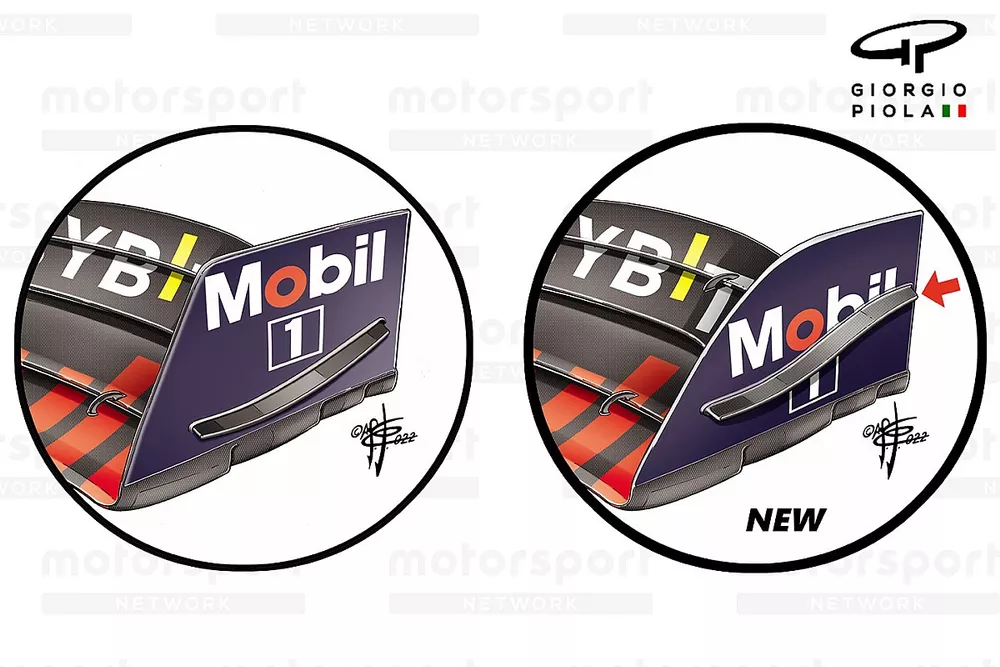
The very first hint of its weight saving – albeit a minor one – appeared at the Australian Grand Prix, with a new front wing design that featured both aerodynamic revision and, according to its official explanation to the FIA, some weight-saving tweaks too as it reduces the overall volume and weight of the assembly.
The changes to the front wing endplate are quite obvious when compared with the previous specification, as not only has the leading and top edge been reprofiled, but so too has the diveplane.
The more angular leading edge of the endplate has given way to a much more gradual curvature, which also significantly reduces the length of the upper edge, as the team looks to tweak the airflow's behaviour ahead of the front tyre.
This is compounded by the arrival of the S-shaped diveplane, which sees the rear section in a higher position than the older specification, whilst also being mounted closer to the trailing edge.
However, the shape means this final section of the diveplane is not pitched as aggressively as its predecessor.
It's worth remembering that the teams are heavily restricted in what they can do with the design of the endplate and diveplane in order to limit how much outwash can be generated.
It's also not the first time we've seen the S-shaped diveplane variant employed, with Alpine and Alfa Romeo also favouring the arrangement.
Other Melbourne upgrades
McLaren MCL36 rear brake winglet comparison
Photo by: Uncredited
McLaren settled on changes to its rear brake winglet's end fence layout in Australia, which is a component that teams have far less design freedom with than they had in the past.
But rather than taking away material, as has been the trend up until this point, the team increased the size of the end fence (see dotted line on the right-hand image).
These winglets are important when we consider not only the local flow distribution but also how they can have an impact on the wake shed from the tyre and the diffuser alongside, with even the most minimal of changes able to have a sizeable effect.
Alpine also investigated the impact of changes in this region of the car, trialling a new end fence layout during free practice, but it didn't appear to make its way onto the car for qualifying and the race.
However, changes made to the outer floor strake did, with the team having already remodelled the design of the strake on several occasions during testing and the first few races in order to optimise its performance.
Alpine A522 outer floor strake comparison
Photo by: Uncredited
It's a change that appears to have an impact further down the floor edge too. Whilst it's clear that the boundary line of the strake has been shifted upward and rearward, to create a more defined rear edge (white dotted line), the floor transition also seems to have more of a bulbous shape too (red arrow).
Like the bargeboards that used to occupy this region of the car, the design of these strakes is going to provide a rich source of performance, not only in its own right but also when allied to any optimisations made to the floor.
Aston Martin AMR22 rear wing comparison
Photo by: Uncredited
For the third race in a row, Aston Martin had a different rear wing at its disposal, as the team looked to strike the right balance between downforce and drag for the prevailing conditions and circuit characteristics.
Notably this rear wing has a more traditional, flat leading edge shape to the mainplane, rather than the spoon-shaped designs that the regulations incite.
This obviously characterises the transition into the endplate, with a tighter radius required depending on the configuration at hand.
Read Also:
- The glowing light that offered clues about Mercedes’ F1 recovery plan
- Russell: "Nothing substantial" coming for Mercedes F1 soon
- F1 crashes holding back Aston Martin's progress with 2022 car
- F1 sprint race format prompts Ferrari to avoid Imola upgrades
We want your opinion!
What would you like to see on Motorsport.com?
Take our 5 minute survey.
- The Motorsport.com Team
Read and post comments
Read also :
Share Or Save This Story
Copy link
Share on Viber
Previous article Ocon: F1 set-up direction to blame for not matching Alonso in Australia
Next article Vasseur: Qualifying setback hid Alfa Romeo pace in Australia
Top Comments
There are no comments at the moment. Would you like to write one?
View More & Comment

More from
Matt Somerfield

Gallery: How F1 tech evolved during the 2024 season
Formula 1
Formula 1
Gallery: How F1 tech evolved during the 2024 season
How McLaren’s rear wing push changed the game in F1
Formula 1
Formula 1
How McLaren’s rear wing push changed the game in F1
How 2026 F1 rules will help avoid identikit designs
Formula 1
Formula 1
How 2026 F1 rules will help avoid identikit designs
Latest news

Why it's now Oliver Bearman versus Rafael Camara for the next Ferrari vacancy
Formula 1
F1 Formula 1
United States GP
3 min
Why it's now Oliver Bearman versus Rafael Camara for the next Ferrari vacancy
MotoGP Australian GP: Marco Bezzecchi leads Aprilia 1-2-4-5 in Friday Practice
MotoGP
MGP MotoGP
Australian GP
2 h
MotoGP Australian GP: Marco Bezzecchi leads Aprilia 1-2-4-5 in Friday Practice
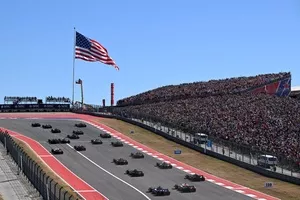
Max Verstappen slams “unacceptable” bumps at Austin F1 track: “It's out of control”
Formula 1
F1 Formula 1
United States GP
9 h
Max Verstappen slams “unacceptable” bumps at Austin F1 track: “It's out of control”

Kimi Antonelli ready to "finish the job" as first F1 title chance beckons at US GP
Formula 1
F1 Formula 1
United States GP
10 h
Kimi Antonelli ready to "finish the job" as first F1 title chance beckons at US GP
Feature
Discover prime content




Subscribe and access Motorsport.com with your ad-blocker.
From Formula 1 to MotoGP we report straight from the paddock because we love our sport, just like you. In order to keep delivering our expert journalism, our website uses advertising. Still, we want to give you the opportunity to enjoy an ad-free and tracker-free website and to continue using your adblocker.
You have 2 options:
- Become a subscriber.
- Disable your adblocker.
Subscribe now Already subscribed? Sign in here
Already disabled your adblocker?
Reload page
Manage Alerts
Subscribe