


Remembering Colin Chapman: 1928-1982
Thirty years have gone by since the death of Colin Chapman. Many still reflect on his innovations to this day. Many of them are still being used today. The Lotus name leaves on, and there are still Lotus Seven's found on race tracks!

It seems strange to realize that 30 years have passed since the death of Anthony Colin Bruce Chapman. At the same time, one has to wonder what Colin Chapman would think about the modern era of Formula One, and the fight over the naming rights of Lotus.
Hailing from Hornsey, Great Britain, Chapman attended the University College in London studying mechanical engineering but not for finely-tuned racing machines; instead he was interesting in airplanes. At the university, Chapman was active in the Air Squadron where he learned to fly. At the age of 20, he was a pilot in the Royal Air Force. While he, like many young men, was deciding which direction he would take in his life, Chapman started to buy and resell used cars. He then went to work for the British Aluminum Company.
When he purchased a 1930 Austin Seven, his life ended up taking him for a ride that many dream of but never reach.
Chapman and friends used their knowledge and skills to rebuild a 1930 Austin Seven which they ended up calling “Lotus” due to all the changes they made. In 1952, he and Michael Allen founded the Lotus Engineering Company with his portion coming from his then-girlfriend Hazel, whom he later married.
By 1956, his first single-seater racing car was built, and history was made. The Formula 2 Lotus 12 was a success so Chapman turned his attention to the premier series entering grand prix events. Two Lotus 12s were ready for Graham Hill and Cliff Allison in 1958. Chapman was not happy with the Lotus 16s, and thus his new challenger in 1960 was a Lotus 18 with a rear-engine to power his Team Lotus drivers.
Success as a constructor for Lotus came at Monaco when the Rob Walker team with Stirling Moss driving took the victory over Ferrari in 1960. One year later Chapman’s Team Lotus earned their maiden F1 victory in the USA with Innes Ireland.
With the growth of the company, both in formula cars and road cars, the name Lotus was known throughout out the world. Sports car teams were racing the brand named after a flower; especially the Lotus Seven. Soon the Elan and the Cortina were seen not only on the roads but also on the race tracks.
From a garage rebuilding an Austin Seven, along with his own racing endeavors, Chapman ended up with seven Formula One Constructors' championships. His drivers for the Team Lotus Formula One team landed six World Champion titles. Team Lotus also took one Indianapolis 500 victory.
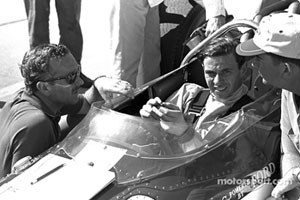
The second one came two years later when Jochen Rindt did not survive a crash in the Lotus 72 during practice for the Italian Grand Prix in 1970; however he did end up taking the F1 championship, posthumously.
The other three championships came from Graham Hill, Emerson Fittipaldi, and Mario Andretti. Chapman’s Lotus team landed their first and only Indy 500 win with Clark in 1965.
Andretti’s 1978 championship was clouded in grief with the death of his teammate Ronnie Peterson on the first lap of the Italian Grand Prix at Monza. The tragic scene with at least nine racers involved will never be forgotten including three of the F1 drivers who despite the fire pulled Peterson out of his car. The Swedish driver did not survive but his points netted him second in the championship.
Reflecting on the loss of his friend, Andretti commented, "It was so unfair to have a tragedy connected with probably what should have been the happiest day of my career.”
Chapman was a pioneer in motor sports and he kept up with the latest technology, and his engineering skills and technics were at times ‘the cutting edge’.
He developed the use of struts as a rear suspension device; hence the words ‘Chapman struts’ for the ones used in the rear on any vehicle.
Chapman was the one who brought the monocoque chassis construction to automobile racing. The first usage was the 1962 Lotus 25. The technique allowed the body to be lighter and stronger, but yet offered more protection for the driver in case of a crash.
Wonder what he would think of today’s Formula One cars. Would he have had a ‘rubber nose’? Or would he approve of DSR? Bet Chapman and Adrian Newey could have interesting conversation on new innovations. That would be an interesting pairing.
Chapman once said, "Adding power makes you faster on the straights. Subtracting weight makes you faster everywhere.”
Share Or Save This Story

Whincup takes his fifth V8 Supercars championship

Perez beats McLaren on his departure

Tiga Race Cars share first peek of their LM214

Who belongs on F1's Mount Rushmore? Pick your four greatest drivers

What F1 history tells us about three-way title deciders

How Graham Hill and Bob Bondurant saved Sir Jackie Stewart's life at the 1966 Belgian GP


Ferrari’s Vigna on Vasseur and fake news: “There is only one reality”

Lewis Hamilton labels Sepang qualifying as "best lap" of his 2026 F1 season

The problem with Ferrari’s endless team principal speculation

Elfyn Evans set for “all in or nothing” approach to WRC title showdown

Why Sheldon Creed is going to Sam Hunt Racing in 2027

Kyle Busch Remembered: Rowdy's wildest and most impressive moments at Las Vegas home track

Sheldon Creed leaves Haas for Sam Hunt Racing in multi-year NASCAR O'Reilly deal

You Ask The Questions: Emerson Fittipaldi

The wide world of strategy options expected in F1's Bahrain GP in Malaysia

How drivers waiting in the wings can still make their presence count in F1

What we learned from Friday practice at the 2026 Bahrain GP in Malaysia
Subscribe and access Motorsport.com with your ad-blocker.
From Formula 1 to MotoGP we report straight from the paddock because we love our sport, just like you. In order to keep delivering our expert journalism, our website uses advertising. Still, we want to give you the opportunity to enjoy an ad-free and tracker-free website and to continue using your adblocker.


Top Comments