


The changes that will help Mercedes avoid more 'magic button' trouble
Lewis Hamilton's magic button fumble in Baku may have been a rare mistake from the seven-time Formula 1 world champion, but Mercedes says it can do more to help him.


Giorgio Piola's F1 technical analysis
Giorgio Piola is the preeminent Formula 1 technical journalist. View our full selection of Giorgio's technical illustrative content
The Briton had surged into the lead of the Azerbaijan Grand Prix at the red flag restart, but he slid down the Turn 1 escape road after a triggering of his 'brake magic' system moved all the braking force to his front wheels.
While Hamilton immediately confessed to his error, Mercedes says it cannot shirk its own responsibilities in providing a car that is more foolproof.
Mercedes' technology director Mike Elliott admitted as much in the team's post race debrief video.
"Lewis makes so few mistakes and that's what really sets him apart from some of the other drivers" said Elliott.
"It's our duty to try and give him a car where it's more difficult for him to make mistakes. We need to take our share of that, look at how we can improve that and that's something we will put in place for the next race."
The likely solution for this weekend's French GP may well be a simple one, such as a software change or a protective guard over the magic button, but Hamilton may also need to slightly revise the placing of his hands.
Hamilton's hand position during race starts has come under the spotlight, as the Briton regularly holds the upper left hand corner of the steering wheel as he operates the clutch paddle with his right hand.

Mercedes AMG F1 W12, steering wheel back of Lewis Hamilton
Photo by: Giorgio Piola
This means the 'brake magic' button, in the upper corner of the Mercedes wheel, is so agonisingly close to his hand during race starts – and it may explain how it was so easy to trigger during the ultra short blast to Turn 1 at Baku from the race start.
As Elliott explained: "He made a fantastic start. He got himself up alongside Perez and as he and Perez were sort of shuffling position Lewis swerved and in the process of swerving he just clipped the magic button and unfortunately he didn't feel he had done it."
Although the Baku error was the first time that the brake magic was visibly accidentally deployed, the process of moving the brake balance in such a way is not a new thing.
Hamilton has had the same steering wheel configuration since 2019, with a single wishbone clutch paddle favoured over the twin paddle arrangement he had prior to that.
The new hand position on the upper corner of the wheel for race starts coincided with the new paddle arrangement, and is clearly something that helps with clutch feel and control given that the FIA eradicated bite point finders a few years prior.

Mercedes W12 steering wheel, rear view
Photo by: Mark Sutton / Motorsport Images
Valtteri Bottas has persevered with the shorter paddle arrangement, meaning he can operate the clutch with either of the paddles during a race start.
What is brake magic?
The drivers normally have their bias set anywhere between 50-60% forward, depending on the prevailing corner they are approaching.
They can adjust this in various ways and increments via the brake balance buttons and rotary switches on the steering wheel.
Meanwhile, software coordinates the amount of braking force completed at the rear of the car by the traditional brakes, based on how much energy is being recovered by the MGU-K.

Mercedes W12 steering wheel detail
Photo by: Mercedes AMG
When brake magic is deployed, the brake balance is shifted almost entirely to the front brakes and so Hamilton inadvertently selected around 90 percent forward brake bias, which caused the front brakes to lock and left him no alternative but to run wide in the first corner.
Brake magic is considered a preparation tool and provides the driver with a means of priming the front tyres, something that is even more critical this season given the change in construction and profile, which has led to a larger offset between the front and rear tyres.
Heat generated by the brakes is radiated through the brake drum into the wheel rim and increases the bulk tyre temperature as a consequence.
This is obviously complicated by the team's use of the brake assembly as an aerodynamic aid, with some of the airflow bypassing the brakes.
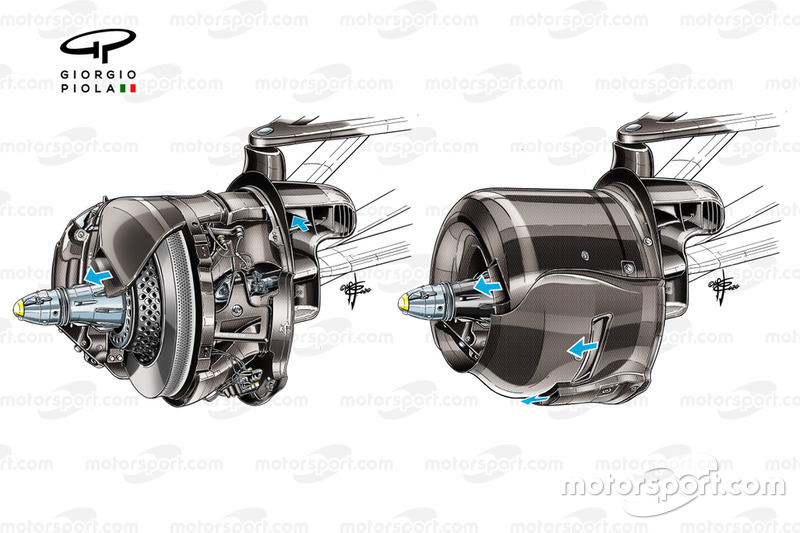
Mercedes AMG F1 W11 brake flow
Photo by: Giorgio Piola
However, with brake magic enabled there's more than enough heat being generated to optimise the tyre's temperatures during a formation lap, which is what Hamilton had planned and why the brakes appeared to be smoking whilst he waited for the race to get underway.
The drivers have access to all sorts of information on their steering wheel display, with one of those options being a temperature readout for each tyre, which aids the driver in meeting their desired target temperature using various methods, including weaving, conventional braking or brake magic.
Share Or Save This Story


Gallery: How F1 tech evolved during the 2024 season

How McLaren’s rear wing push changed the game in F1

How 2026 F1 rules will help avoid identikit designs


Lewis Hamilton “lucky to make it round” after Spanish GP brake failure

Red Bull defends decision to force Max Verstappen to give back two positions

Lewis Hamilton and Fred Vasseur recall GP2 title and 'most impressive race ever', 20 years on


Nico Rosberg stunned by Kimi Antonelli's "unbelievable" maturity in 2026 F1 title fight

George Russell told to turn focus to 2027 as title bid branded "a write-off" after Spanish GP

How Kimi Antonelli is proving unbeatable, even when he's beaten

What Colapinto learned from Gasly's Monza pole to make his Madrid breakthrough

Why Gateway is so hard on NASCAR Cup Series brakes

Lando Norris completes first full test in McLaren’s Le Mans Hypercar

Title hopes over, Gounon injured: Why did Nicki Thiim lose control?

Why Lando Norris doesn’t buy George Russell’s driving style theory

How Kimi Antonelli is proving unbeatable, even when he's beaten

How Norris unfurled a surprising - and "unrepeatable" - Spanish GP pole lap

Audi’s long road back to the top of grand prix racing
Subscribe and access Motorsport.com with your ad-blocker.
From Formula 1 to MotoGP we report straight from the paddock because we love our sport, just like you. In order to keep delivering our expert journalism, our website uses advertising. Still, we want to give you the opportunity to enjoy an ad-free and tracker-free website and to continue using your adblocker.


Top Comments