Analysis
Formula 1
The computer weapon that has given F1 confidence over 2022 rules
Formula 1 fans may be full of excitement for the new car designs that will roll out this week, but the true answer about the success of the 2022 rules is still some way off.

Jonathan Noble
Edited: Feb 8, 2022, 7:50 AM
Copy link
Share on Viber
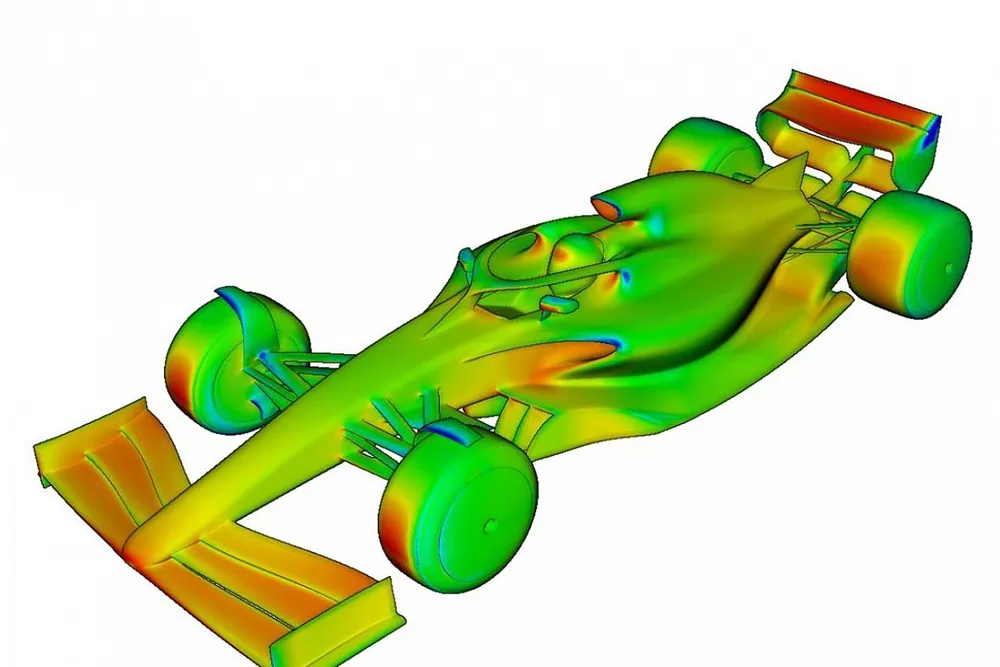
As Haas technical director Simone Resta said on Friday after the reveal of his team's VF-22 images: "So far everyone has been playing with models, whether it is a wind tunnel scale model or whether it is virtual model, simulator, simulation etc. It's all in the virtual world. There's nothing on track.
"The only thing that matters is on track performance with the drivers. We really need to see how the package will work, how it will interact with the tyres, how it will interact with the setup, etc.
"We can only be able to judge and improve the following once we will be able to stay one second behind another car in a fast corner, and understand how the delivery will be if compared to 2021."
Resta's cautiousness is based on the times that the FIA and F1 chiefs have pushed on with bold rule changes to improve the spectacle, only for them to fall flat when the cars ran in the real world.
One of the most famous examples was the 2009 regulation overhaul that was aimed at tidying up the aero of the cars to help them follow each other better.
FIA work on simulating airflow turbulence left the sport's chiefs hopeful that the tweaks would work; but the teams scuppered things by over-riding the intention of the rules through their quest for performance.
The way the team's aero panned out actually disrupted the wake in such a way that it made it difficult for the cars to follow each other.
As the FIA's current head of single seater matters Nikolas Tombazis, who worked for Ferrari at the time, said: "The rules were just full of so many freedoms that within a few weeks of windtunnel testing, and obviously I was sitting on the other side of the fence [working for a team], we had totally negated all the good things that had been thought of."
As F1 heads into a much bigger rules shake up than even 2009, there is a much-increased level of confidence from the sport's chiefs about how the regulations will deliver.
Jenson Button, Brawn GP BGP001 Mercedes
Photo by: Steve Etherington / Motorsport Images
And the basis of that has come from F1 and the FIA having done much more work themselves on framing the regulations than was ever done before.
Perhaps more crucially, though, F1 was able to call upon technology that was far in advance and much more powerful than anything that teams are allowed to use themselves.
So rather than being at the beck-and-call of teams trying to help out in their own spare time, F1 was on the front foot and much further down the park working by itself.
That was because of a partnership that F1 has with AWS, using its cloud technology to run CFD simulations that reduced the average time of runs enough to give F1 and the FIA a huge edge in framing the rules.
As F1's lead engineer Rob Smedley told Motorsport.com: "It has somewhat revolutionised and transformed the way that the FIA were able to write the rules."
What was critical for F1 and the FIA in its research was being able to run two cars together, for only then can the full impact of air disturbance be analysed to work out what was needed to let them run close.
The complexity and processing power of doing that was beyond what teams could deliver in a realistic timeframe, which is why the AWS solution has proved to be such a game-changer.
Smedley explains: "The key technological barrier was that we needed to have a CFD simulation with two cars.
"A CFD simulation with one car, if you run that under the team's aerodynamic test restrictions, then that half car with something like 200 cores is around about five hours.
"And just to geek out for a minute: that's about 100 million cells within that simulation. When you go to a full car, you get up to about 200-250 million cells. So using the 192 cores of the team's simulation, that then puts that full car up to 14 hours.
"If we wanted to use that same technology and computational power within the teams, then a two-car simulation with double the number of cells gets you to 550-600 million cells - and that would be four days.
"So when we first set off on this journey, it was four days to do a single iteration. It's just something that's prohibitive. It's a barrier to the research and development needed."
Rob Smedley, Formula 1
Photo by: Mark Sutton / Motorsport Images
F1 knew it needed to find another solution, which is why the AWS offering proved such a benefit in drastically cutting down the time it took to do runs.
"I think the first iteration was spinning up in their EC2 service, at 1000/1100 cores, and version two, we're up to about 2500 cores," continued Smedley.
"It got that design iteration down from four days to around about six to eight hours.
"We were back to the same situation of where the teams are when they do a half car, and we were doing full two car simulations.
"The progress there in terms of tech was massive. That was enabled by us partnering with AWS and they were the real enablers and the key ingredient there to make that work.
"But the point was we had to get the simulations and the iterations done at a fast enough speed. That design loop was as fast as we could go in order to keep up and be able to write the rules in a way that we have."
Can a 2009 repeat of teams wrecking the intentions of the rules be completely ruled out then?
Smedley, having enjoyed a lengthy career that included spells at Ferrari and Williams, fully accepts that the way teams approach the rulebook is not with the same mindset as the regulators.
So he's aware that competitors will probe grey areas in the chase for performance, and that could scupper F1's best intentions. But he doesn't think they will.
"Certainly the concept, the aerodynamic architecture of what we're trying to create here with a semi ground effect car and an upwashing wake, that is undoubtedly the direction that we needed to take if we wanted to reduce the effect of the wake on the car behind.
"So, from a theoretical or a scientific point of view, there's no doubt that the concept is fundamentally sound.
"The fundamental truth is the teams will chase performance as quickly as they can, in whatever direction they can, and it's possible obviously that they will find performance, which is unhelpful to the car behind - and they won't go out of their way to stop that."
Haas VF-22
Photo by: Haas F1 Team
That unpredictability of how the teams will approach the regulations and potentially derail F1's best intentions means Smedley is not foolish to guarantee that the 2022 rules will work perfectly.
But he says there is a degree of confidence about the starting point, and that if improvements need to be made, F1 can respond.
Read Also:
- Horner fulfils Qatar F1 GP “rogue marshal” offence obligation
- Mercedes “absolutely desperate” to see 2022 F1 power unit run
- Red Bull: ‘No risk, no fun’ F1 attitude foundation for Verstappen success
"I think that's the beauty of F1. If you knew all the answers right now and we sat down and we've worked it all out, certainly for me and for people like me, F1 would become quite boring.
"It's like Ross Brawn always says, we can't hope to get it right first off. But let's have a look to see that we've made a step forward.
"And if we've made a step forward, and then there's more fundamental steps we can take after that, after one year of learning in 2022, that's great.
"Let's continue to do that and let's just continue to build a better sport."
We want your opinion!
What would you like to see on Motorsport.com?
Take our 5 minute survey.
- The Motorsport.com Team
Read and post comments
Read also :
Share Or Save This Story
Copy link
Share on Viber
Previous article Verstappen wins Autosport’s International Racing Driver of the Year Award
Next article The design trends to watch in the 2022 F1 car launches
Top Comments
There are no comments at the moment. Would you like to write one?
View More & Comment

More from
Jonathan Noble

Brundle awarded OBE in King’s New Year’s honours
Formula 1
Formula 1
Brundle awarded OBE in King’s New Year’s honours
The new rules dilemma that will define the 2025 F1 season
Formula 1
Formula 1
The new rules dilemma that will define the 2025 F1 season
Verstappen issues Red Bull title warning in push for RB21 progress
Formula 1
Formula 1
Australian GP
Verstappen issues Red Bull title warning in push for RB21 progress
Latest news
FIA stewards explain Charles Leclerc’s five-second penalty in F1 Mexico GP
Formula 1
F1 Formula 1
Mexican GP
43 min
FIA stewards explain Charles Leclerc’s five-second penalty in F1 Mexico GP
LIVE: F1 Mexico GP updates - Can Kimi Antonelli seal the title?
Formula 1
F1 Formula 1
Mexican GP
2 h
LIVE: F1 Mexico GP updates - Can Kimi Antonelli seal the title?
What does Yamaha’s shock MotoGP boycott mean for F1 in Qatar and Abu Dhabi?
Formula 1
F1 Formula 1
Qatar GP
3 h
What does Yamaha’s shock MotoGP boycott mean for F1 in Qatar and Abu Dhabi?
Feature
Discover prime content

Subscribe and access Motorsport.com with your ad-blocker.
From Formula 1 to MotoGP we report straight from the paddock because we love our sport, just like you. In order to keep delivering our expert journalism, our website uses advertising. Still, we want to give you the opportunity to enjoy an ad-free and tracker-free website and to continue using your adblocker.
You have 2 options:
- Become a subscriber.
- Disable your adblocker.
Subscribe now Already subscribed? Sign in here
Already disabled your adblocker?
Reload page
Manage Alerts
Subscribe