Nostalgia
Formula 1
The secrets of Formula 1's six-wheeled racer
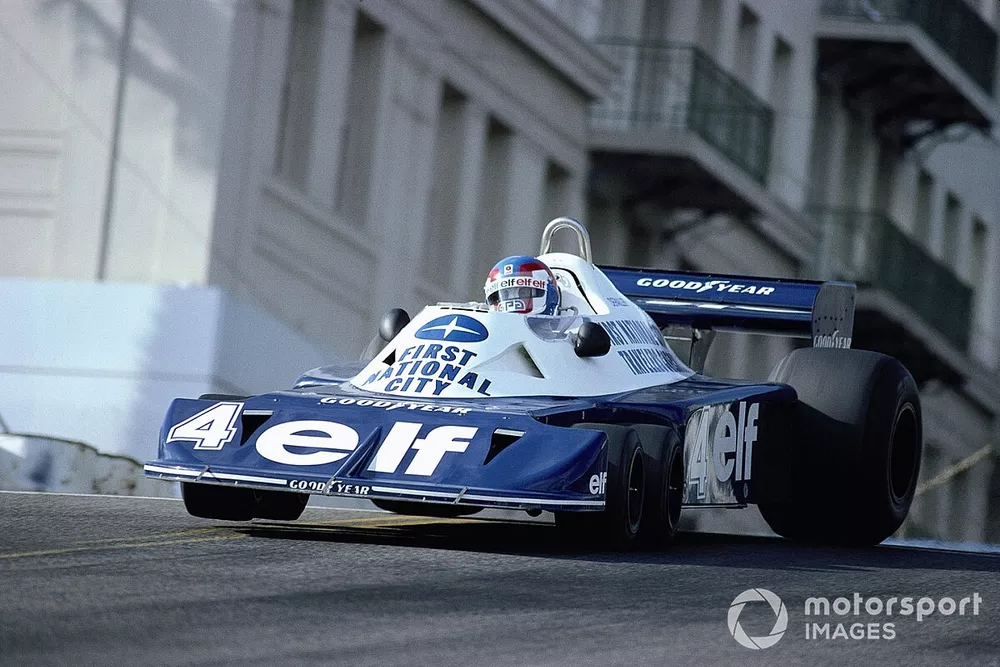
On this day in 1976, one of Formula 1’s most unique cars made its debut at the Spanish Grand Prix when Tyrrell introduced its infamous six-wheeled P34.
Giorgio Piola Matt Somerfield
Edited: May 2, 2023, 7:18 AM
Copy link
Share on Viber
Giorgio Piola's F1 technical analysis
Giorgio Piola is the preeminent Formula 1 technical journalist. View our full selection of Giorgio's technical illustrative content
The P34 was the product of lateral thinking at Tyrrell, as it looked for a way to outsmart its rivals, most of whom were using the same Cosworth DFV engine and the Hewland gearbox.
Technical director Derek Gardner’s ambitious plan was to use four smaller wheels at the front of the car, as he hoped that their compact size plus sitting them in behind the front wing, rather than above it, would lead to a reduction in drag and perhaps even increase the car's agility.
The P34 featured four 10” wheels mounted at the front of the chassis, with the steering directly attached to the front axle, whilst a bell crank arrangement was used to steer the second.
Tyrrell P34 1977 front suspension comparison
Photo by: Giorgio Piola
It was also anticipated that with four wheels at the front, rather than two, braking would be improved.
However, it turned out that one unintended consequence here was a bigger headache in cooling the brakes, with numerous solutions arising in an effort to improve the issue.
The other problem it had was the car's wheelbase would be either shortened or lengthened if one axle became unloaded or locked-up before the other.
This made driving and setting up the P34 especially difficult, and due to the wheels being much smaller at the front, they also went through more revolutions than their larger counterparts at the rear of the car.
This had a significant impact on the tyre’s lifespan, a problem that was further exacerbated by Goodyear's improvement of the rear tyre and lack of development of the small front tyres.
Giorgio Piola had unprecedented access to the car during this period and takes up the story…
"It all happened by pure coincidence, as I was flying out to Rio and ended up sitting beside Ken Tyrrell on the flight," he said. "In life you need to be good, but also lucky.”
Tyrrell knew of Giorgio’s work and asked if he would be interested in doing the press kit for his team’s car, which meant he could get a lot of information and take a lot of pictures of the car.
"It was some of my best work, I was very attached to that car, as I had a good relationship with Tyrrell’s chief designer - Derek Gardner. I did three big cutaways of the car and an incredibly detailed top view that Derek helped me with."
The top view is incredibly detailed and one of the most difficult drawings Piola has done, as he explains that with the cutaway drawings you can often use tricks, like putting bodywork over an area you’re not sure about and want to obscure.
However, this overview drawing had to be extremely accurate, with everything precisely where it should be, even down to the position of the pipework.
"For me it was one of the best drawings I’ve ever done, but no-one would publish it at the time as it had 32 annotations,” explained Piola. “This was too much detail and not something that could be published in a magazine at that time, and due to it being a huge hand-drawn illustration the arrows and numbers couldn’t be removed."
So, we can now exclusively reveal the work as he originally intended, complete with a run-down of the annotations.
Tyrrell P34 exploded top view
Photo by: Giorgio Piola
- Adjustable aluminium splitter
- NACA- shaped air ducts in the front wing fed air through to the brakes via pipework [6]
- Adjustable Gurney flaps
- Brake and clutch master cylinders
- Fire extinguisher for the engine
- Pipework feeding cool air from the front wing through to the brakes
- Steering arm
- Vented front brake discs
- 10” wheels
- Clutch pedal
- Steering Column
- Cockpit fire extinguisher
- Goodyear’s specially commissioned tyres
- Front rollover hoop
- Removable cockpit bodywork
- Bodywork recess to give access to the fuel fillers
- Sidepod bodywork
- Gear-shift lever mechanism
- Fuel filler caps for the side tanks
- Left-hand fuel cell trap
- Water pot
- Rear rollover hoop
- Oil Tank
- Right-hand oil cooler
- Right-hand radiator
- Cosworth DFV V8 engine
- Hewland FG400 gearbox
- Inboard rear lockheed brake calipers
- Left-hand brake air scoop
- Rear anti-roll bar
- Rear Wing
- Right-hand exhaust
Jody Scheckter, Tyrrell P34-Ford, stops in front of his team after the win
Photo by: Motorsport Images
The P34 did have its moment in the sun, taking victory at the Swedish GP, but the issue it had with the tyres continued to be exacerbated by a lack of development from Goodyear and the eventual downfall of the project.
The P34 was withdrawn from service following the 1977 season and six-wheel designs were subsequently banned.
While Tyrrell’s foray into this solution had seen it add an axle at the front of the car, several other teams had seen an opportunity to do similar at the rear.
Williams FW08 1982 comparison with FW08B six wheeler
Photo by: Giorgio Piola
Unable to acquire a turbocharged engine, Williams set about trying to find a way to level the playing field. While Ferrari and March also had six wheel projects of their own, Williams had the most race ready of the trio.
Four wheels at the front was a dead end though, as proven by Goodyear’s lack of development on the 10” tyre for Tyrrell’s P34. Instead, Williams would focus its efforts at the rear of the car but still with the intent of reducing drag.
The rear tyre was still much wider than those used at the front of the car, so Williams proposed using two front tyres in series at the rear of the car.
This approach not only gave the requisite drag reduction but came with the added benefits of four-wheel drive and an increase in the car's wheelbase.
Able to place the narrower wheels further out, it was able to lengthen and widen the Venturi tunnels and bodywork all the way to the rear of the car, resulting in a significant increase in downforce from ground effect.
Williams had put extensive effort into converting the FW07 to test out the theory and even planned on racing the FW08 in that guise. That is until the governing body banned four-wheel drive, which proved to be even more infuriating for Patrick Head when he was told by Sir Frank Williams that he’d agreed to it, in a meeting with the other teams at Maranello.
Patrick Head’s attempt at a six-wheeled machine would have been a massive step forward for Williams, with the car reportedly a handful of seconds quicker than its predecessor. Alas, it wasn’t to be and the car was shelved without having turned a wheel competitively.
Alan Jones, 6-wheel Williams FW07D
We want your opinion!
What would you like to see on Motorsport.com?
Take our 5 minute survey.
- The Motorsport.com Team
Read and post comments
Read also :
Share Or Save This Story
Copy link
Share on Viber
Previous article How McLaren and Ferrari went to war with the rules in '76
Next article F1's most dominant drive of the last 25 years
Top Comments
There are no comments at the moment. Would you like to write one?
View More & Comment
More from
Giorgio Piola
The fascinating story behind McLaren's most iconic F1 car
Formula 1
Formula 1
The fascinating story behind McLaren's most iconic F1 car
Emilia Romagna GP: F1 technical images from Imola's pitlane
Formula 1
Formula 1
Emilia Romagna GP
Emilia Romagna GP: F1 technical images from Imola's pitlane
The F1 downforce choices that proved key at the Saudi GP
Formula 1
Formula 1
Saudi Arabian GP
The F1 downforce choices that proved key at the Saudi GP
More from
Tyrrell
What F1 history tells us about three-way title deciders
Formula 1
Formula 1
Abu Dhabi GP
What F1 history tells us about three-way title deciders
Pironi – The man who should have been France’s first F1 champ
Formula 1
Formula 1
Pironi – The man who should have been France’s first F1 champ
Latest news

Why Daniel Ricciardo is staying away from the F1 paddock
Formula 1
F1 Formula 1 12 min
Why Daniel Ricciardo is staying away from the F1 paddock
Top 10 F1 cars of the 1960s
Formula 1
Top 10 F1 cars of the 1960s
Esteban Ocon's F1 career may be ending, but his story is one of success
Formula 1
F1 Formula 1 2 h
Esteban Ocon's F1 career may be ending, but his story is one of success
“We let him down” – Mercedes takes blame for George Russell’s Mexico GP heartbreak
Formula 1
F1 Formula 1
Mexican GP
2 h
“We let him down” – Mercedes takes blame for George Russell’s Mexico GP heartbreak
Feature
Discover prime content
Top 10 F1 cars of the 1960s
Formula 1
By Kevin Turner
Top 10 F1 cars of the 1960s


Subscribe and access Motorsport.com with your ad-blocker.
From Formula 1 to MotoGP we report straight from the paddock because we love our sport, just like you. In order to keep delivering our expert journalism, our website uses advertising. Still, we want to give you the opportunity to enjoy an ad-free and tracker-free website and to continue using your adblocker.
You have 2 options:
- Become a subscriber.
- Disable your adblocker.
Subscribe now Already subscribed? Sign in here
Already disabled your adblocker?
Reload page
Manage Alerts
Subscribe