


Bite-size tech: Ferrari's under chassis 'bat-wing'
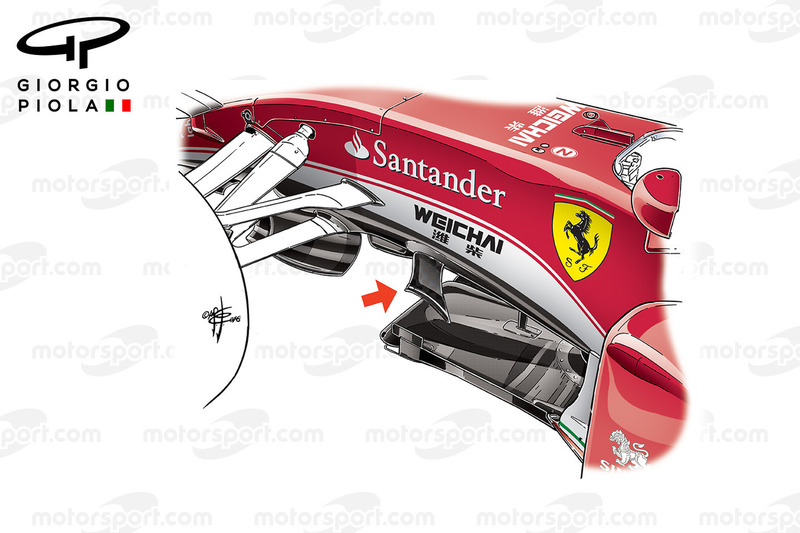
Ferrari's updates for the Malaysian GP include an old bedfellow, as the SF16-H has been seen with an under chassis 'bat-wing' during practice.

Giorgio Piola's F1 technical analysis
Giorgio Piola is the preeminent Formula 1 technical journalist. View our full selection of Giorgio's technical illustrative content
It's an appendage first brought to prominence by Mercedes in 2014, and used by the championship leader ever since. Sitting astride the ride height sensor it helps to redirect airflow moving under the car's nose and chassis to improve flow downstream.
Ferrari employed a 'bat-wing' in the latter phases of 2015, with the appendage used on the SF15-T from the US GP onwards but, its change to a 'thumb' style nose and revised turning vanes in 2016 has excluded its use thus far.
The new 'bat-wing' comes as part of a package, with a new set of turning vanes paired to them to improve how airflow moves down and around the sidepod's undercut, whilst also more accurately defining the Y250 vortex shed by the front wing.
Earlier in the season the the team chased another concept, when it introduced a set of chassis vanes at Silverstone this year.
These vanes perform a similar role to the 'bat-wing' and have also been tested in FP3 as the team looks to balance the SF16-H's performance around the varied Sepang circuit layout.
As always it's the compromise between outright speed on the long straights versus balance and downforce for the reprofiled corners that make these nuanced differences so important.
Share Or Save This Story

The fascinating story behind McLaren's most iconic F1 car

Emilia Romagna GP: F1 technical images from Imola's pitlane

The F1 downforce choices that proved key at the Saudi GP


Charles Leclerc: Ferrari must learn from Red Bull to improve F1 race strategy

Charles Leclerc explains why Bahrain GP chaos has reinforced F1 driver fears

How the Bahrain GP in Malaysia exposed Red Bull’s hidden resurgence

2026 Singapore Grand Prix: Guide to schedule, driver meet-ups, and race week parties

Jeb Burton joins RSS Racing, will drive father Ward Burton's No. 22

Stewart Friesen to run Kyle Busch throwback scheme in Charlotte NASCAR Truck race

Red Bull is overcoming ADUO restrictions but still calls on tweaks for F1 2027

Three kings: F1's generational stars shone at Sepang

How F1 let a golden opportunity slip at Sepang

How the Bahrain GP in Malaysia exposed Red Bull’s hidden resurgence

You Ask The Questions: Emerson Fittipaldi
Subscribe and access Motorsport.com with your ad-blocker.
From Formula 1 to MotoGP we report straight from the paddock because we love our sport, just like you. In order to keep delivering our expert journalism, our website uses advertising. Still, we want to give you the opportunity to enjoy an ad-free and tracker-free website and to continue using your adblocker.


Top Comments