




Tech analysis: Ferrari's medium downforce update
Ferrari has undoubtedly made a significant stride forward in 2017 and seemingly has a car for all conditions but the team is obviously not resting on its laurels, as it introduced a revamped aero kit for the Canadian GP.

Giorgio Piola's F1 technical analysis
Giorgio Piola is the preeminent Formula 1 technical journalist. View our full selection of Giorgio's technical illustrative content
The focus of the update was to provide the drivers with an aerodynamic set-up to suit the medium downforce characteristics of the Circuit Gilles Villeneuve. The update included a revision of Ferrari's sidepod deflectors, a new floor and a rear wing assembly.
Sidepod deflectors

We’ve already waxed lyrical about the elaborate design of the SF70H’s sidepods and surrounding machinations but one aspect that has been left out thus far is the deflectors, a unique design befitting its surroundings.
Outwardly it may seem like a simple design, however, the trapezoidal element has some nice features, including an unusually thick leading edge and a pair of louvres used to displace pressure.
It’s also much shorter than the deflectors we’ve come to know over the last five-six years but this is more than made up by its length and intricacy.
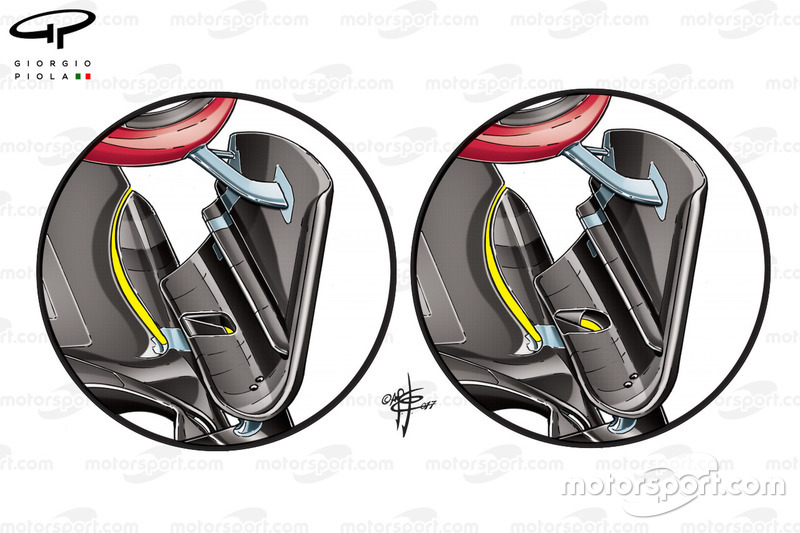
A small change was made to the deflector's footplate for Canada, with the hole midway along its length slightly revised, altering the way in which airflow passes by.
Floor
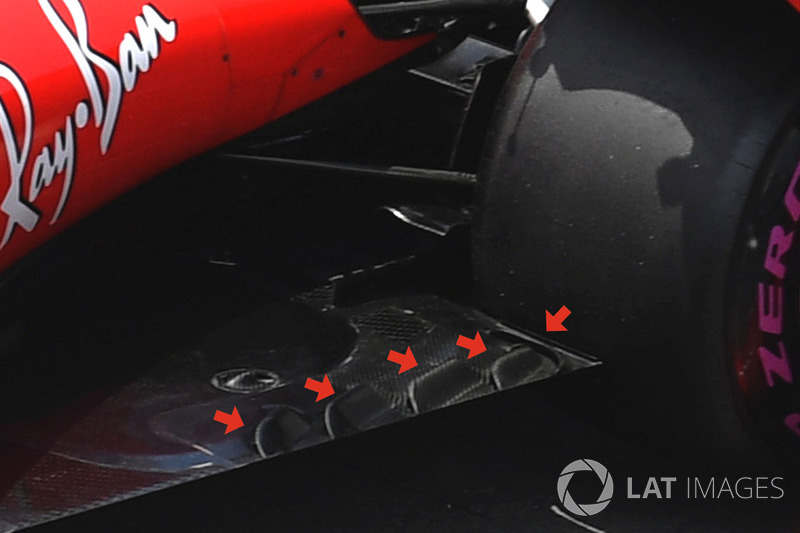
The development of solutions ahead of the rear tyre has intensified over the last few seasons, as teams try to perfect ways of defending against tyre squirt - the lateral displacement of air into the diffuser as rear tyre deforms under load.
Most teams now favour the use of numerous L-shaped slots in the floor ahead of the rear tyre, of which Ferrari are one. However, their geometry, orientation and frequency can have a significant bearing on how they perform and so it’s no surprise to see changes made to suit the differing circuit characteristics.
Ferrari has opted to utilise another L-shaped slot in Canada, taking its tally to four, while a wider slot has been placed just ahead of the floors trailing edge.
These slots allow pressure to bleed from one side of the floor to the other, changing how the air moves across and around the face of the tyre, creating a seal against the airflow that tries to push its way into the diffuser's path.
Rear wing
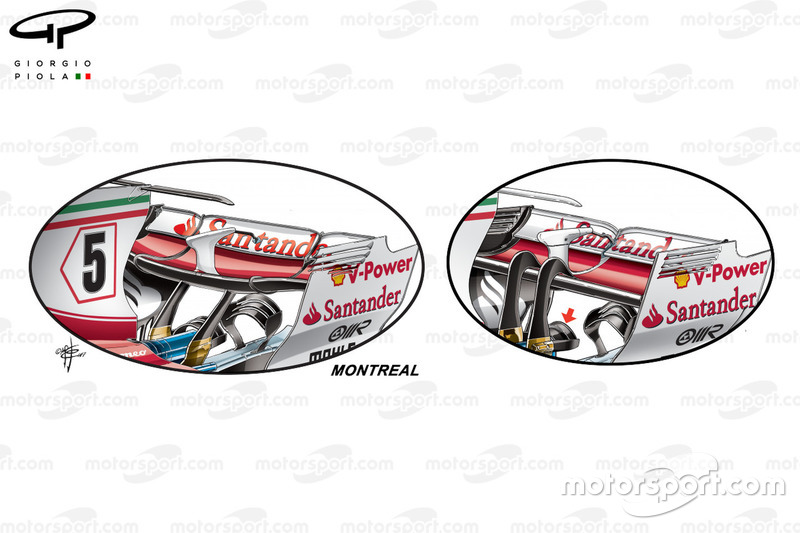
Ferrari has introduced an entirely new rear wing structure for the Canadian GP, which features a spoon-shaped mainplane and upper flap, much like the one run by Mercedes for most of the season.
The deeper, more forward-placed central section of the wing means the team has also had to change the way in which their rear wing is supported, with two centre pillars mounted to the underside of the wing, rather than utilising a swan-neck design.
In order that the team take the maximum from these changes, the endplates have also been optimised, as Ferrari has finally gone for the open-end style louvre bandwagon that has been circling since Toro Rosso first introduced them at the start of 2016.
Meanwhile, the slots that would ordinarily run from the base of the endplate upward have also been curtailed in an effort to change overall shape of the tip vortex created, when the differing pressure gradients meet at the flap and endplate juncture.
This has also led to Ferrari revisiting the more simplistic single element T-wing design, albeit painted in black rather than white, with its design not only inferring a few points of downforce in its own right but also shaped to change the rear wing's tip vortex.
The exhaust-wrapping monkey seat used in Monaco (right inset) for additional downforce is also surplus to requirements, with the less aggressive version run in the preceding races re-installed.
Share Or Save This Story


Gallery: How F1 tech evolved during the 2024 season

How McLaren’s rear wing push changed the game in F1

How 2026 F1 rules will help avoid identikit designs


The slick tyre gamble that hurt McLaren and Ferrari's Bahrain F1 chances

Ferrari’s Vigna on Vasseur and fake news: “There is only one reality”

The problem with Ferrari’s endless team principal speculation

Explained: What was really going on with the FIA software bug causing F1 chaos in Malaysia

"Horrible, totally unacceptable" - Powerless F1 drivers frustrated by Bahrain F1 software glitch

WRC Sardinia: Elfyn Evans claims historic title after Oliver Solberg crashes in final-stage showdown

The slick tyre gamble that hurt McLaren and Ferrari's Bahrain F1 chances

You Ask The Questions: Emerson Fittipaldi

The wide world of strategy options expected in F1's Bahrain GP in Malaysia

How drivers waiting in the wings can still make their presence count in F1

What we learned from Friday practice at the 2026 Bahrain GP in Malaysia
Subscribe and access Motorsport.com with your ad-blocker.
From Formula 1 to MotoGP we report straight from the paddock because we love our sport, just like you. In order to keep delivering our expert journalism, our website uses advertising. Still, we want to give you the opportunity to enjoy an ad-free and tracker-free website and to continue using your adblocker.


Top Comments