Breaking news
Formula 1
Loopholes unlikely in "very restrictive" 2019 rules - Lowe
Formula 1 teams have made a concerted effort to ensure the 2019 aerodynamic rules do not leave any loopholes that can be exploited, according to Williams technical chief Paddy Lowe.
Matt Beer Adam Cooper
Edited: Jan 3, 2019, 12:44 PM
Copy link
Share on Viber
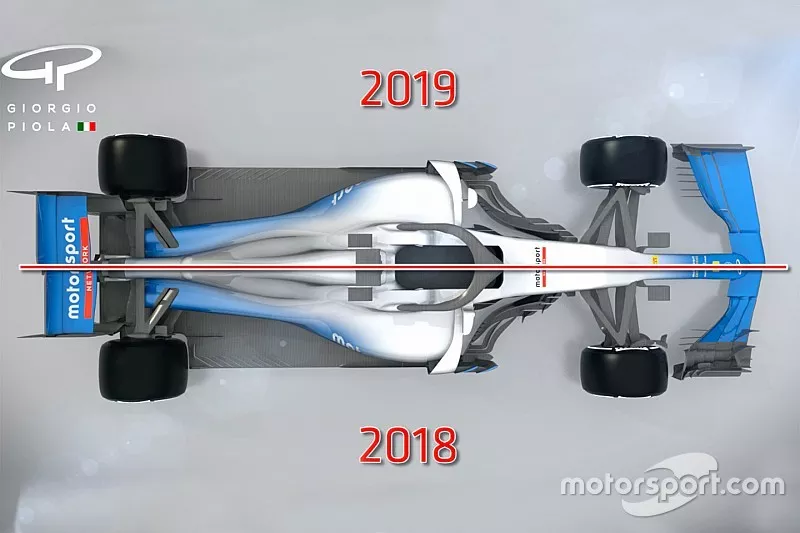
As a first push in Liberty Media's bid to increase the amount of overtaking in F1, this year's cars will feature a number of changes designed to make them less aerodynamically sensitive when following each other.
Previous rules shake-ups have allowed some teams to gain an advantage by pouncing on ambiguities - most famously with the double diffuser concept that shock championship winner Brawn GP, Toyota and Williams deployed in 2009.
Lowe feels it is unlikely there will be a repeat of that scenario 10 years on.
"The teams have been quite ready and open, at least some of them, to put stuff on the table that's then been heavily constrained," Lowe told Motorsport.com.
"The regulations are very restrictive. I hope it's the case for everybody else, but we're struggling to find a lot of performance out of these front wings.
"I think generally the teams are of a mindset that they want clarity, and not to have a lot of arguments when we turn up in Australia over poorly defined aspects of the regs.
"With that spirit, everybody has been quite enthusiastic to define things in more and more specific details so everybody knows what they're working with."
From the editor, also read:
Force India technical director Andrew Green agreed that the scope for shocks looks limited in the final version of the rules.
"Hopefully that is a set of regulations that everyone can work with," he told Motorsport.com.
"And there's not a huge loophole. There might be little ones in there, hopefully there's not anything massive that people can dive into.
"It just goes to show how difficult is to write a set of regulations that are tied to a specific [aerodynamic] geometry. The tighter you make the regulation, the longer the regulation becomes.
"You just give people a box to work in, it's a very simple regulation, but everybody comes up with incredibly complicated solutions.
"One of the reasons why it has changed is to try get rid of those complicated solutions.
"So, it's an incredibly complicated set of regulations to have an end result of an incredibly simple set of geometry."
We want your opinion!
What would you like to see on Motorsport.com?
Take our 5 minute survey.
- The Motorsport.com Team
Read and post comments
Read also :
Share Or Save This Story
Copy link
Share on Viber
Previous article Mercedes: "Founding father" Schumacher key to F1 dominance
Next article F1 discussed limiting Friday practice to "base tyre" running
Top Comments
There are no comments at the moment. Would you like to write one?
View More & Comment
More from
Matt Beer

Ferrari drivers escape punishment for clash
Formula 1
Formula 1
Brazilian GP
Ferrari drivers escape punishment for clash

Hamilton accepts full responsibility for Albon collision
Formula 1
Formula 1
Brazilian GP
Hamilton accepts full responsibility for Albon collision

Vettel, Leclerc called to stewards over accident
Formula 1
Formula 1
Brazilian GP
Vettel, Leclerc called to stewards over accident
Latest news
Carson Hocevar says Zane Smith feud is "pretty one-sided"
NASCAR Cup
NAS NASCAR Cup
Talladega II
1 h
Carson Hocevar says Zane Smith feud is "pretty one-sided"
Jack Miller says Australian GP cancellation “tough to swallow”: “It is pissing me off”
MotoGP
MGP MotoGP
Australian GP
2 h
Jack Miller says Australian GP cancellation “tough to swallow”: “It is pissing me off”
Max Verstappen reacts to COTA boss: "He can drive my car, after five laps he won't be able to walk"
Formula 1
F1 Formula 1
United States GP
2 h
Max Verstappen reacts to COTA boss: "He can drive my car, after five laps he won't be able to walk"

Sammy Smith just pulled off a rare Talladega feat not seen in over twenty years
NASCAR O'Reilly
NOAP NASCAR O'Reilly
Talladega II
2 h
Sammy Smith just pulled off a rare Talladega feat not seen in over twenty years
Feature
Discover prime content



Subscribe and access Motorsport.com with your ad-blocker.
From Formula 1 to MotoGP we report straight from the paddock because we love our sport, just like you. In order to keep delivering our expert journalism, our website uses advertising. Still, we want to give you the opportunity to enjoy an ad-free and tracker-free website and to continue using your adblocker.
You have 2 options:
- Become a subscriber.
- Disable your adblocker.
Subscribe now Already subscribed? Sign in here
Already disabled your adblocker?
Reload page
Manage Alerts
Subscribe