Breaking news
Formula 1
Ferrari F1 aero "fragile" thanks to correlation issues
Ferrari says a correlation problem between design figures and how its SF1000 performed on track left its Formula 1 car aerodynamically 'fragile' in its current spec.

Jonathan Noble
Edited: Jul 3, 2020, 1:49 PM
Copy link
Share on Viber
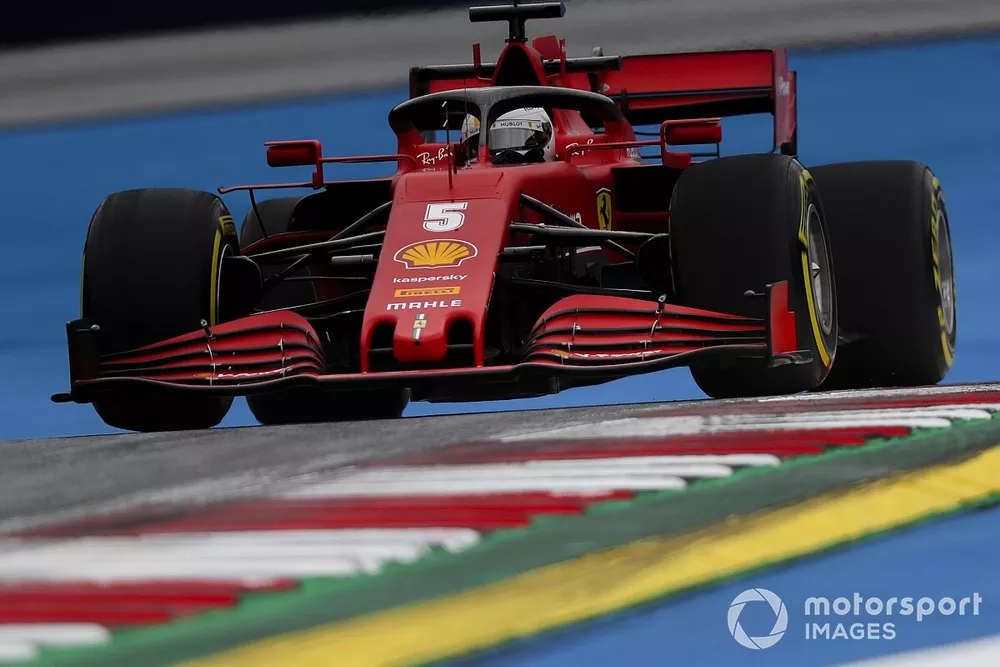
With the team working on a major revision that will start to roll out for the Hungarian Grand Prix, team principal Mattia Binotto spoke on Friday about what had gone wrong with its work over the winter.
Having made a decision to push hard to ramp up the downforce, Binotto said that it meant that the car wasn’t as robust in aero performance as was needed to take the fight to Mercedes and Red Bull.
“In winter testing the car was not performing as expected,” he said, when asked by Motorsport.com to explain its findings from the early running.
“The car on track was not performing as we saw in the design that we did at home, so there was a miscorrelation from design to track.
“Obviously we had to understand it first. We started trying really to understand it as soon as we were back home at the factory, and during the shutdown period that was not possible. I think we realised that, from the aero point of view mainly, there were some miscorrelations.
“Eventually I think we [realised we] pushed a lot our project, on trying to seek a lot of downforce to lift up what was our situation last year in terms of weaknesses. I think that eventually whatever we developed was too fragile in terms of aero robustness when being on track.”
Read Also:
- Leclerc sure Ferrari will struggle more than in 2019
- Ferrari still blocking release of FIA engine settlement details
Binotto suggested that there would be a programme of updates aimed at turning around the performance of the car, with only the first step being brought in for the Hungaroring race later this month.
“What we are trying to do now is simply to step back, try to understand, reassess the problem and move forward later on.
“Our hope is to bring some developments already in Hungary, nothing before. And hopefully by Hungary, we will not address all our issues, but we will have a definite step forward in our performance. I think by then, we can understand where we are compared to our main competitors.”
We want your opinion!
What would you like to see on Motorsport.com?
Take our 5 minute survey.
- The Motorsport.com Team
Read and post comments
Read also :
Share Or Save This Story
Copy link
Share on Viber
Previous article Ferrari still blocking release of FIA engine settlement details
Next article Renault won't update F1 engine during 2020 season
Top Comments
There are no comments at the moment. Would you like to write one?
View More & Comment

More from
Jonathan Noble

Brundle awarded OBE in King’s New Year’s honours
Formula 1
Formula 1
Brundle awarded OBE in King’s New Year’s honours
The new rules dilemma that will define the 2025 F1 season
Formula 1
Formula 1
The new rules dilemma that will define the 2025 F1 season
Verstappen issues Red Bull title warning in push for RB21 progress
Formula 1
Formula 1
Australian GP
Verstappen issues Red Bull title warning in push for RB21 progress
More from
Scuderia Ferrari

Charles Leclerc and Pecco Bagnaia: From kings to princes
MotoGP
MotoGP
Charles Leclerc and Pecco Bagnaia: From kings to princes

Sainz blasts "most unfair penalty ever", seeks stewards' explanation
Formula 1
Formula 1
Australian GP
Sainz blasts "most unfair penalty ever", seeks stewards' explanation

Calado: "Difficult" for WEC Hypercar newcomers "to win straight off"
WEC
WEC
Calado: "Difficult" for WEC Hypercar newcomers "to win straight off"
Latest news
NASCAR is getting the championship finish it has pursued since 1992
NASCAR Cup
NAS NASCAR Cup
Phoenix II
14 min
NASCAR is getting the championship finish it has pursued since 1992

Zane Smith furious as he slams into Carson Hocevar after NASCAR Cup race
NASCAR Cup
NAS NASCAR Cup
Phoenix II
25 min
Zane Smith furious as he slams into Carson Hocevar after NASCAR Cup race

Complete NASCAR Cup points standings after 2026 Phoenix II
NASCAR Cup
NAS NASCAR Cup
Phoenix II
59 min
Complete NASCAR Cup points standings after 2026 Phoenix II
Kyle Larson reacts as points lead completely vanishes in costly Phoenix wreck
NASCAR Cup
NAS NASCAR Cup
Phoenix II
1 h
Kyle Larson reacts as points lead completely vanishes in costly Phoenix wreck
Feature
Discover prime content



Subscribe and access Motorsport.com with your ad-blocker.
From Formula 1 to MotoGP we report straight from the paddock because we love our sport, just like you. In order to keep delivering our expert journalism, our website uses advertising. Still, we want to give you the opportunity to enjoy an ad-free and tracker-free website and to continue using your adblocker.
You have 2 options:
- Become a subscriber.
- Disable your adblocker.
Subscribe now Already subscribed? Sign in here
Already disabled your adblocker?
Reload page
Manage Alerts
Subscribe