Formula 1 Canadian GP
Why new Mercedes front wing is critical to cure its main F1 weakness
Mercedes has explained why its new front wing is so critical to unlocking the balance improvement that it hopes can help transform its Formula 1 season.

Jonathan Noble
Published: Jun 8, 2024, 10:28 AM
Copy link
Share on Viber
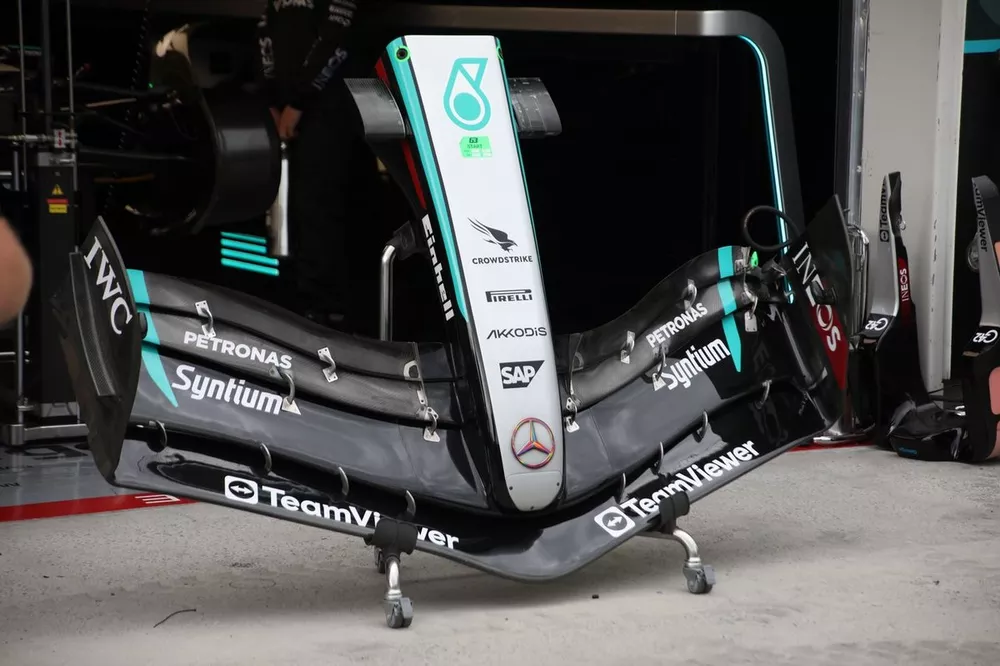
The German manufacturer has been struggling with a car that does not perform consistently well across both high- and low-speed corners.
The team has found that if it improves its speed in one type of turn, then the other suffers. So, for example, a good set-up to eradicate low-speed understeer would result in the car enduring oversteer in the fast stuff.
Key to getting on top of this problem is ensuring that the car has a greater consistency of aero balance in different speed ranges.
As Mercedes technical director James Allison explains, there are ways to try to manage this mechanically – but that opens the potential for the car to behave in a way that is not good for driver confidence.
A much better way of doing it is in coming up with a wing that does not result in such an extreme shift of aero characteristics.
"You can do things with the mechanical balance which help you fight the inherent tendency to low-speed understeer, high-speed oversteer," he said. "The more extreme you make that, the more tricky the car feels to drive.
"But if you sort of take away the aerodynamic unhappiness that that mechanical balance is fighting, then you can have a less extreme mechanical balance migration in a car that feels more consistent and predictable to the driver."
Lewis Hamilton, Mercedes F1 W15
Photo by: Glenn Dunbar / Motorsport Images
Taking away that aerodynamic unhappiness has come through the creation of the new front wing, which works in a way not to shift the aero balance as far forward when the car is running at high speeds.
As Allison explained: "I think all these cars like being near the ground, which is why they are near the ground. The front wings on these cars are very big and they probably like being near the ground the most of all.
"That tends to make a car get more nervous as it goes faster, because predominantly and proportionately more [balance] is moving to the front axle than you might wish. And so, you're fighting that with these rules.
"The more you find downforce near the ground, the worse that gets. Everyone in 2022 when these rules were first published weren't as near to the ground as they are now.
"We weren't fighting this inherent behaviour as much then as we are now. And this [wing] is just helpful with that."
Flexi-wing battle
How Mercedes achieves its aim of a wing that doesn't keep ramping up the downforce as it gains speed is a less clear matter – as it probably steps into the realms of complicated aero elasticity (aka flexi-wings).
Having the wing's elements flex back to a small degree at high speed can reduce its downforce-producing characteristics to help with this balance issue.
It is a trait that has been increasingly spotted on other cars and now looks like being something every team is going to have to pursue if it wants to be competitive - while being mindful of full compliance with the regulations.
As Allison explained: "It's clearly a thing that helps fight the inherent behaviour that I just explained."
Lewis Hamilton, Mercedes F1 W15
Photo by: Glenn Dunbar / Motorsport Images
The trick is to create a wing that passes the FIA flexibility tests taking place in the pitlane, but then does what the team wants when it is out on track.
Allison added: "I think that all of us are trying to ensure that we pass the FIA's flexibility test. They put loads on, and you've got to not move by more than an amount.
"But provided you can do that and provided your wing is just bending like a thing bends when it has load on it, then there's no drama to be faced with the governing body."
While Montreal, because a lot of its corners are taken at a similar speed, is perhaps not the best of tracks to show off the potential of the new wing, Allison thinks that the gains will be more obvious at some venues coming up.
"It's helpful, you just don't get the maximum amount of benefit compared with a track with a wider range of cornering speeds," he said. "But hopefully more helpful at future tracks."

We want your opinion!
What would you like to see on Motorsport.com?
Take our 5 minute survey.
- The Motorsport.com Team
Read and post comments
Read also :
Share Or Save This Story
Copy link
Share on Viber
Previous article Verstappen concerned about "implications" of Montreal F1 engine issue
Next article Alonso: Conditions will make Canada F1 weekend one big "gamble"
Top Comments
There are no comments at the moment. Would you like to write one?
View More & Comment

More from
Jonathan Noble

Brundle awarded OBE in King’s New Year’s honours
Formula 1
Formula 1
Brundle awarded OBE in King’s New Year’s honours
The new rules dilemma that will define the 2025 F1 season
Formula 1
Formula 1
The new rules dilemma that will define the 2025 F1 season
Verstappen issues Red Bull title warning in push for RB21 progress
Formula 1
Formula 1
Australian GP
Verstappen issues Red Bull title warning in push for RB21 progress

More from
Mercedes
“We let him down” – Mercedes takes blame for George Russell’s Mexico GP heartbreak
Formula 1
Formula 1
Mexican GP
23 h
“We let him down” – Mercedes takes blame for George Russell’s Mexico GP heartbreak
The 'difference' between Kimi Antonelli's F1 title and Lewis Hamilton's according to Toto Wolff
Formula 1
Formula 1
Mexican GP
The 'difference' between Kimi Antonelli's F1 title and Lewis Hamilton's according to Toto Wolff
Latest news

1980 F1 world champion Alan Jones dies aged 80
Formula 1
F1 Formula 1 16 min
1980 F1 world champion Alan Jones dies aged 80

WEC title showdown: How Toyota’s two crews can win the crown at Monza
WEC
WEC WEC
Monza
18 min
WEC title showdown: How Toyota’s two crews can win the crown at Monza

Honda names Jake Dixon as Joan Mir's substitute for Qatar GP
MotoGP
MGP MotoGP
Malaysian GP
29 min
Honda names Jake Dixon as Joan Mir's substitute for Qatar GP

2026 MotoGP Qatar Grand Prix – How to watch, session times & more
MotoGP
MGP MotoGP
Qatar GP
53 min
2026 MotoGP Qatar Grand Prix – How to watch, session times & more
Feature
Discover prime content
Top 10 F1 cars of the 1960s
Formula 1
By Kevin Turner
Top 10 F1 cars of the 1960s


Subscribe and access Motorsport.com with your ad-blocker.
From Formula 1 to MotoGP we report straight from the paddock because we love our sport, just like you. In order to keep delivering our expert journalism, our website uses advertising. Still, we want to give you the opportunity to enjoy an ad-free and tracker-free website and to continue using your adblocker.
You have 2 options:
- Become a subscriber.
- Disable your adblocker.
Subscribe now Already subscribed? Sign in here
Already disabled your adblocker?
Reload page
Manage Alerts
Subscribe