Analysis
WEC 24 Hours of Le Mans
Analysis: Why the 2026 Le Mans 24 Hours might be the most competitive ever
During the official test day, the whole Hypercar field set faster lap times than ever before at Circuit de la Sarthe

Heiko Stritzke
Edited: Jun 9, 2026, 5:42 PM
Copy link
Share on Viber

Aston Martin Valkyrie
Photo by: Rainier Ehrhardt
The Hypercar class for the 2026 Le Mans 24 Hours is shaping up to be more competitive than ever.
While Aston Martin claimed the headlines on the test day, reigning three-time winner Ferrari found itself unexpectedly shuffled into the midfield, signaling a major shift in the balance of power ahead of the 94th running of the French endurance classic.
The fastest lap of Sunday’s test went to the #007 Aston Martin Valkyrie with a time of 3m26.293s. While this falls just short of the fastest lap from last year’s test day (a 3m26.246s set by the #8 Toyota), it masks a much more significant trend: the overall speed of the field has drastically improved compared to 2025.
Every single Hypercar entrant managed to deliver lap times below the 3:30-minute mark on a consistent basis. This uniformity highlights a significantly tighter grid.
In fact, the total number of individual laps recorded below 3m30s at the test day more than doubled, skyrocketing from 178 laps in 2025 to 362 laps in 2026 – an astonishing statistic considering the grid is made up of 18 Hypercars this year compared to last year’s 21.
Breaking down the numbers
Number of Sub-3:27 laptimes (3m26.000s to 3m26.999s):
2025: 3
2026: 7
Number of Sub-3:28 laptimes:
2025: further 19
2026: further 71
Number of Sub-3:29 laptimes:
2025: further 27
2026: further 121
Number of Sub-3:30 laptimes:
2025: further 129
2026: further 163
This data proves that breaking the 3m30s barrier is no longer a milestone reserved for a select few; it has become the baseline. More hypercars than ever are now comfortably running deep into the 3m28s and 3m27s.
While entering the 3m26 range remains a highly exclusive club, even that elite circle more than doubled its membership this year at the test day.
Four manufacturers edge ahead
Overall, a much tighter race can be expected compared to the mostly two-horse races of the past years. Looking at the average lap times of all cars below 3m34s, a representative picture of true ultimate pace emerges:
- Toyota #7 – 3m29.189s
- Cadillac #12 – 3m29.312s
- Toyota #8 – 3m29.447s
- Alpine #35 – 3m29.659s
- Cadillac #38 – 3m29.777s
- Aston Martin #009 – 3m29.937s
- Alpine #36 – 3m30.008s
- BMW #20 – 3m30.088s
- WTR-Cadillac #101 – 3m30.094s
- Ferrari #50 - 3m30.128s
- Aston Martin #007 - 3m30.172s
- Ferrari #51 - 3m30.197s
- AF Corse Ferrari #83 - 3m30.299s
- Genesis #19 - 3m30.396s
- Peugeot #93 - 3m30.572s
- Genesis #17 - 3m30.597s
- BMW #15 - 3m30.693s
- Peugeot #94 - 3m30.757s
To ensure accuracy, cancelled lap times were included in this analysis. The time advantage gained by exceeding track limits at the Corvette curves is minimal, and retaining these laps provides a fairer assessment of a car's consistent speed.
For instance, the #7 Toyota GR010 Hybrid had its two fastest morning laps deleted. Excluding them would have dropped its calculated average to 3m29.327s. Including them, however, reflects the car’s genuine performance capability.
The averages reveal a leading group composed of four manufacturers: Toyota, Cadillac, Alpine and Aston Martin. BMW and Ferrari form the midfield, while class debutant Genesis and Peugeot are currently lagging slightly behind.
Crucially, the gaps are drastically smaller than last year. With 11 cars representing 7 different manufacturers separated by less than a single second on average, even the smallest performance optimisation before Wednesday’s opening practice sessions could turn the pecking order upside down.
Evolution of performance: Who made the biggest leap?
To understand how the competitive landscape shifted, we compared each car's average lap time (using the same sub-3m34 criteria) between the 2025 and 2026 test days. The performance gains:
- Toyota #7 1.966s faster
- Aston Martin #009 1.963s faster
- Aston Martin #007 1.613s faster
- Cadillac #12 1.535s faster
- Alpine #35 1.505s faster
- WTR-Cadillac #101 1.505s faster
- Alpine #36 1.405s faster
- Peugeot #93 1.035s faster
- Peugeot #94 0.944s faster
- Toyota #8 0.931s faster
- Cadillac #38 0.814s faster
- BMW #20 0.733s faster
- Ferrari #50 0.678s faster
- BMW #15 0,421s faster
- Ferrari #51 0,017s faster
- AF Corse Ferrari #83 0,459s slower
Unsurprisingly, Aston Martin made the most spectacular step forward. Since Le Mans 2025 was only the fourth race in the Valkyrie’s developmental program, substantial year-on-year improvements were anticipated, and the British brand delivered.
Substantial progress was also made by Toyota and the established LMDh platforms from Cadillac and Alpine. BMW unlocked solid evolutionary steps with its heavily overhauled M Hybrid V8, but the gains are significantly smaller.
Peugeot has also found some pace in its still compromised 9X8, finding around one second. However, last year’s car was so uncompetitive at Le Mans that these gains only allowed the lions to catch up to the field.
In stark contrast, Ferrari has effectively stagnated at its 2025 performance level. Because the rest of the Hypercar grid advanced so aggressively, the Italian manufacturer’s steady state caused the Prancing Horse to fall back into the midfield on test day.
After securing three consecutive victories at the Circuit de la Sarthe, it was widely expected that the competition would eventually close the gap to Ferrari.
However, with the Balance of Performance (BoP) calculations kept strictly confidential this year, one can only speculate on how much the Italian manufacturer has been slowed down and how much of it is down to the steps made by the competition.
Watch: The Rolex 24 at Daytona: Precision, Perfection, and The Road To Victory (IMSA Endurance Racing)
Read Also:
We want your opinion!
What would you like to see on Motorsport.com?
Take our 5 minute survey.
- The Motorsport.com Team
Read and post comments
Read also :
Share Or Save This Story
Copy link
Share on Viber
Previous article Le Mans 24 Hours: Aston Martin fastest at test day
Next article Vincent Vosse on BMW, IMSA and the future of endurance racing
Top Comments
There are no comments at the moment. Would you like to write one?
View More & Comment

More from
Heiko Stritzke

Porsche boss Laudenbach says he is "not happy" with how things were handled by IMSA in 2026
IMSA
IMSA
Porsche boss Laudenbach says he is "not happy" with how things were handled by IMSA in 2026

Philipp Eng and BMW to part ways after 11 years
IMSA
IMSA
Philipp Eng and BMW to part ways after 11 years

Max Verstappen defends Chris Lulham after online abuse
GT World Challenge Europe Endurance
GT World Challenge Europe Endurance
Max Verstappen defends Chris Lulham after online abuse
Latest news
F1 United States GP live commentary and updates - FP2
Formula 1
F1 Formula 1
United States GP
13 min
F1 United States GP live commentary and updates - FP2
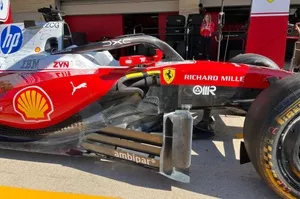
Exploring Ferrari's 'less than a tenth' US GP update package
Formula 1
F1 Formula 1
United States GP
38 min
Exploring Ferrari's 'less than a tenth' US GP update package
F1 United States GP: Charles Leclerc pips Max Verstappen to top FP1
Formula 1
F1 Formula 1
United States GP
2 h
F1 United States GP: Charles Leclerc pips Max Verstappen to top FP1

George Russell reveals he lost sleep over his own driving, not the F1 championship
Formula 1
F1 Formula 1
United States GP
2 h
George Russell reveals he lost sleep over his own driving, not the F1 championship
Feature
Discover prime content




Subscribe and access Motorsport.com with your ad-blocker.
From Formula 1 to MotoGP we report straight from the paddock because we love our sport, just like you. In order to keep delivering our expert journalism, our website uses advertising. Still, we want to give you the opportunity to enjoy an ad-free and tracker-free website and to continue using your adblocker.
You have 2 options:
- Become a subscriber.
- Disable your adblocker.
Subscribe now Already subscribed? Sign in here
Already disabled your adblocker?
Reload page
Manage Alerts
Subscribe