


Bite-size tech: Ferrari SF16-H splitter winglet
Ferrari has installed its new splitter winglet on the SF16-H as it is sent down to the FIA for scrutineering.

Giorgio Piola's F1 technical analysis
Giorgio Piola is the preeminent Formula 1 technical journalist. View our full selection of Giorgio's technical illustrative content
It's something that the team trialled on Sebastian Vettel's car during free practice in Austin.
Unfortunately, running with the appendage was curtailed when Vettel had an excursion across the kerbs at the penultimate corner, as he tried to maintain control of the car with one hand and hold a wing mirror in another that had become detached.

The winglet replaces solutions that have already been employed this season, with chassis winglets introduced at Silverstone (left) and subsequently replaced by the 'bat-wing' solution in Japan (right).

You'll note how similar the new design is to the one introduced by McLaren in Germany (above) and is itself an interpretation of the winglet used by Red Bull since the start of the season.
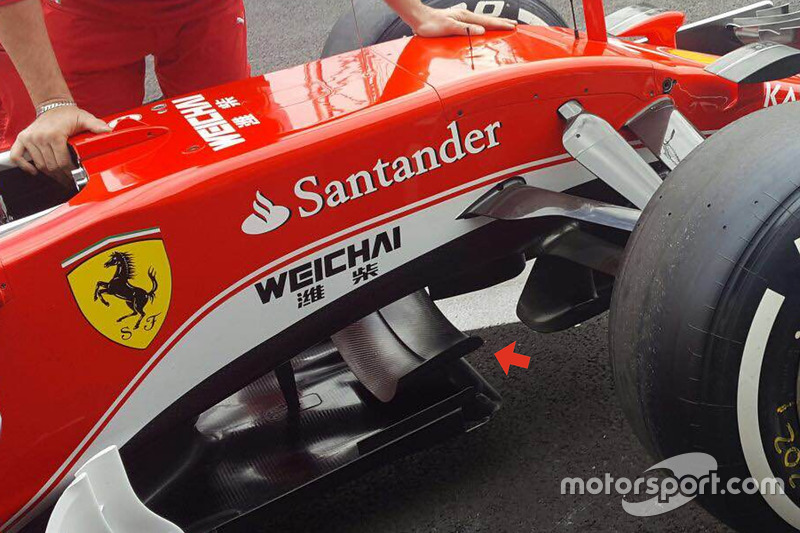
All of these devices, whether run in combination with the turning vanes or the splitter have similar goals - to create vortices that help to reposition the Y250 vortex as it moves down the car.
However, what is interesting is that Ferrari has now trialled at least three different solutions this season as it not only looks to improve the performance of this year's car but also eye the aerodynamic changes that will occur next season.
These changes include but are not limited to the nose being at least 200mm longer, with a minimum length of 1050mm rather than 850mm, which will clearly establish a different relationship between the nose and neutral central section of the wing, changing how the airflow is structured under the nose and chassis.
Secondly, the deltoid shape of the neutral section may change the vorticity and direction of the Y250 vortex. Thirdly, the permitted size of the bargeboards has been increased significantly and will change how the wake of the tyre is dealt with by the surrounding airflow structures.
And lastly, the splitter will be 100mm shorter, allowing the cars to be 'raked' a little more and changing its relationship with the airflow it receives and passes under or over the floor, which will also feature a deltoid shape.
All of these changes have a dramatic effect on how airflow moves around the car, undoubtedly altering the centre of pressure and causing teams to reconsider certain aspects of their design going forward.
Share Or Save This Story

The fascinating story behind McLaren's most iconic F1 car

Emilia Romagna GP: F1 technical images from Imola's pitlane

The F1 downforce choices that proved key at the Saudi GP


Guenther Steiner jokes Christian Horner Ferrari talk is good book publicity

The problem with Ferrari’s endless team principal speculation

Lewis Hamilton honours Roscoe with touching tribute one year after his death

Marc Marquez denies anger on Austrian sprint podium: he was just 'saving energy'

Toyota denies 2027 WEC deal with Esteban Ocon

Honda secretly introduced second F1 ADUO upgrade in Madrid

Yamaha hopes MotoGP race winner Ai Ogura can revive Japan’s “lost” motorcycle passion

As Mercedes looks to deal F1 2026 knockout blow, will its driver fight reignite?

Top 10 F1 results changed by backmarkers – the passes

The problem with Ferrari’s endless team principal speculation

Why Mercedes is still quicker than McLaren
Subscribe and access Motorsport.com with your ad-blocker.
From Formula 1 to MotoGP we report straight from the paddock because we love our sport, just like you. In order to keep delivering our expert journalism, our website uses advertising. Still, we want to give you the opportunity to enjoy an ad-free and tracker-free website and to continue using your adblocker.


Top Comments